August 10, 2026
Case Study: Long-Form Content Driving Traffic Growth
-
Visual Soldiers
- Design
- minute read

Case Study: Long-Form Content Driving Traffic Growth
Quick Summary
A B2B SaaS company significantly improved its website performance by focusing on long-form content. This approach led to a dramatic increase in organic traffic, search visibility, and conversions. Key results included a 2,196% growth in organic impressions and a 5,185% increase in clicks. Additionally, user engagement improved, with users spending 74% more time on pages, indicating higher content quality. This strategy also translated into substantial revenue growth, with organic leads generating $900,000 and achieving a 12x return on investment. The success was attributed to the creation of in-depth, well-structured content that effectively engaged users and boosted the company’s online presence.
Long-form content can transform your website’s performance. This case study reveals how a B2B SaaS company drastically increased organic traffic, search visibility, and conversions by focusing on in-depth, well-structured content. Here’s what worked:
- Traffic Boost: Organic impressions grew by 2,196%, and clicks jumped 5,185%.
- Better Engagement: Users spent 74% more time on pages, signaling higher quality.
- Revenue Growth: Organic leads generated $900,000, delivering a 12x ROI.
The strategy? Focused keyword research, detailed topic clusters, and high-quality content supported by clean, user-friendly design. This approach not only improved rankings but also built authority and trust with users.
Want results like these? Start prioritizing depth, structure, and user intent in your content.
Challenges and Objectives: Why a New Approach Was Needed
Key Challenges the Client Faced
Before the campaign began, the client struggled with more than just low traffic. Their content was thin – short, shallow articles that didn’t address meaningful questions or showcase expertise. This wasn’t unique to them; it’s a common issue across industries. Take one e-commerce brand as an example: they published 154 blog posts but only managed to attract 1,300 monthly visitors. Quantity without quality rarely delivers results. The client faced the risk of falling into the same trap.
Another major issue was the website’s structure. Pages existed in isolation, with no internal links to tie them together. This made it difficult for search engines to recognize the site as an authority on any topic, leaving even their strongest pages struggling to rank. Additionally, the site had zero visibility in AI-generated search results – no mentions in Google AI Overviews or citations in tools like ChatGPT or Perplexity. In today’s search landscape, being invisible in generative AI searches can be a serious disadvantage.
“The biggest hidden cost of bad long-form content is not low rankings – it is the topical authority signal you actively damage by publishing weak material.” – Martial Notarangelo, Founder, Authority Specialist
On top of this, the client’s E-E-A-T (Experience, Expertise, Authoritativeness, Trustworthiness) signals were weak. There were no author pages, structured data, or editorial guidelines, leaving search engines with little reason to view the site as credible. As a result, their rankings were limited to obscure, low-traffic keywords, while high-value commercial terms remained out of reach.
These challenges made it clear that a new strategy was essential to turn things around and build authority.
Setting the Campaign's Goals
To address these issues, the team established clear, measurable goals. The primary focus was to significantly increase monthly organic impressions and drive more organic conversions. But it wasn’t just about boosting traffic – building topical authority was a key priority. The campaign aimed to secure top rankings for high-intent keywords that aligned with the client’s business objectives.
Another important goal was to improve user engagement. By creating content that kept visitors on the page longer, the team could signal to search engines that the site offered real value. Every goal was carefully designed to tackle a specific challenge, laying the groundwork for lasting success.
Strategy Development: Building the Content Plan
Research and Planning
Once the challenges were identified, the team dove into research. They started with a competitor audit to pinpoint high-performing keywords. These keywords were then classified by funnel stage: bottom-of-funnel (BOFU) for ready-to-buy users, mid-funnel (MOFU) for those comparing options, and top-of-funnel (TOFU) for creating awareness. The team prioritized BOFU content first, aiming to attract qualified leads early in the campaign. As Parth Jasrapuria, founder of ContentBuck, explains, this approach can deliver leads as early as the third month.
“A keyword with 200 monthly searches that attracts operations managers evaluating software is worth 10x more than a keyword with 5,000 searches that attracts college students writing a paper.” – Parth Jasrapuria, Founder, ContentBuck
To refine their focus, they filtered keywords based on difficulty (KD < 35) and search volume, ensuring alignment with the current domain authority. This led to a curated list of high-intent topics, grouped into topic clusters. Each cluster revolved around a detailed pillar page (3,000+ words) supported by 8 to 15 shorter articles targeting related subtopics. With these clusters in place, the team created a content framework designed to engage and convert.
Content Structure and Design
After organizing the topic clusters, the team turned its attention to structuring each piece of content. They adopted a “depth-first” approach, addressing the most pressing questions first. As Martial Notarangelo of Authority Specialist explained, word count should be the result of thoroughly covering a topic rather than an arbitrary target.
Each article followed a consistent format designed to balance SEO performance and reader experience. Key elements included:
- A table of contents with jump links.
- H2 sections spanning 200–400 words.
- At least one visual element, such as a comparison table or checklist.
To enhance both usability and searchability, Chunk Sovereignty principles were applied. This meant starting each section with a concise 2–3 sentence summary, making it easier for both AI systems and human readers to quickly identify the core information.
The broader takeaway is that content strategy and design work best together. Even the strongest long-form content benefits from a clear visual hierarchy, intuitive navigation, thoughtful typography, and an experience that makes complex information easier to consume.
Aligning Content with Brand Messaging
The final step was ensuring every piece of content stayed true to the client’s voice and brand identity. To avoid sounding like a generic industry blog, the team developed detailed editorial guidelines. These guidelines defined the brand’s tone, voice, and areas of expertise, addressing any weak E-E-A-T signals directly.
To boost authority, long-form articles featured Practitioner’s Insight sections. These sections offered real-world perspectives tied to the client’s unique experience – something AI-generated content simply can’t replicate. Every decision, from topic selection to writing style, was made with the client’s identity and audience in mind, ensuring the content felt authentic and resonated with readers.

Execution and Implementation
How the Content Was Created
Once the strategy was set, the team moved into production. Instead of relying on generalist writers, the process focused on expert interviews and original research. Writers collaborated directly with industry specialists to gather unique insights. Each long-form article targeted a specific, high-intent topic identified during the keyword research phase, ensuring every piece served a clear purpose from the outset.
To maintain consistent quality at scale, a structured editorial workflow was implemented. This process included several steps: creating a topic brief, conducting expert interviews, drafting the content, undergoing editorial reviews, and final optimization. Additionally, every article featured an AI Summary Box placed directly under the H1 header. These 3–5 sentence summaries provided concise, factual overviews designed to improve visibility in generative search engines like Google AI Overviews and ChatGPT. This addition proved effective in boosting visibility on AI-driven platforms.
From there, the team transitioned this meticulous content creation process into a design that prioritized user engagement and ease of use.
Design and User Experience
Long-form content also depends heavily on the experience surrounding the content itself. Clear typography, consistent heading structures, digestible paragraphs, intuitive navigation, and supporting visual elements can make complex information significantly easier for readers to explore.
In Project Nexus, each article followed a consistent typographic structure from H1 through H3, incorporated shorter, digestible paragraphs, and included visual elements throughout major sections. This approach supported the Chunk Sovereignty principle by making individual sections easier to understand at a glance.
The lesson for brands is simple: publishing in-depth content is only part of the equation. The website experience needs to support that depth by helping visitors quickly navigate, understand, and engage with the information.
Publishing and Promotion Plan
After creating and designing the content, the team executed a structured publishing and promotion plan to maximize its reach. The publishing process followed a strategic order: pillar pages were launched first, followed by related cluster articles over a rolling 4-week period. Each cluster article was linked back to its corresponding pillar page, reinforcing the content hierarchy and distributing link equity. To ensure visibility on generative search platforms, the robots.txt file was updated to explicitly allow AI crawlers such as GPTBot, Claude-Web, and PerplexityBot.
Promotion efforts extended beyond the website. Key articles were manually shared on industry-specific forums and newsletters. At the same time, long-form pillar content was repurposed into email campaigns and social media snippets to broaden its reach. For context, a similar B2B SaaS campaign by Atlanta Legal Tech Solutions (ALTS) saw impressive results using this syndication strategy. Between October 2025 and March 2026, ALTS increased organic impressions from 18,500 to 62,300 – a 236% jump – and achieved a 533% boost in qualified leads.
Why Does Long-Form Content Win Over Time With the Search Engines?
Results: What the Campaign Achieved
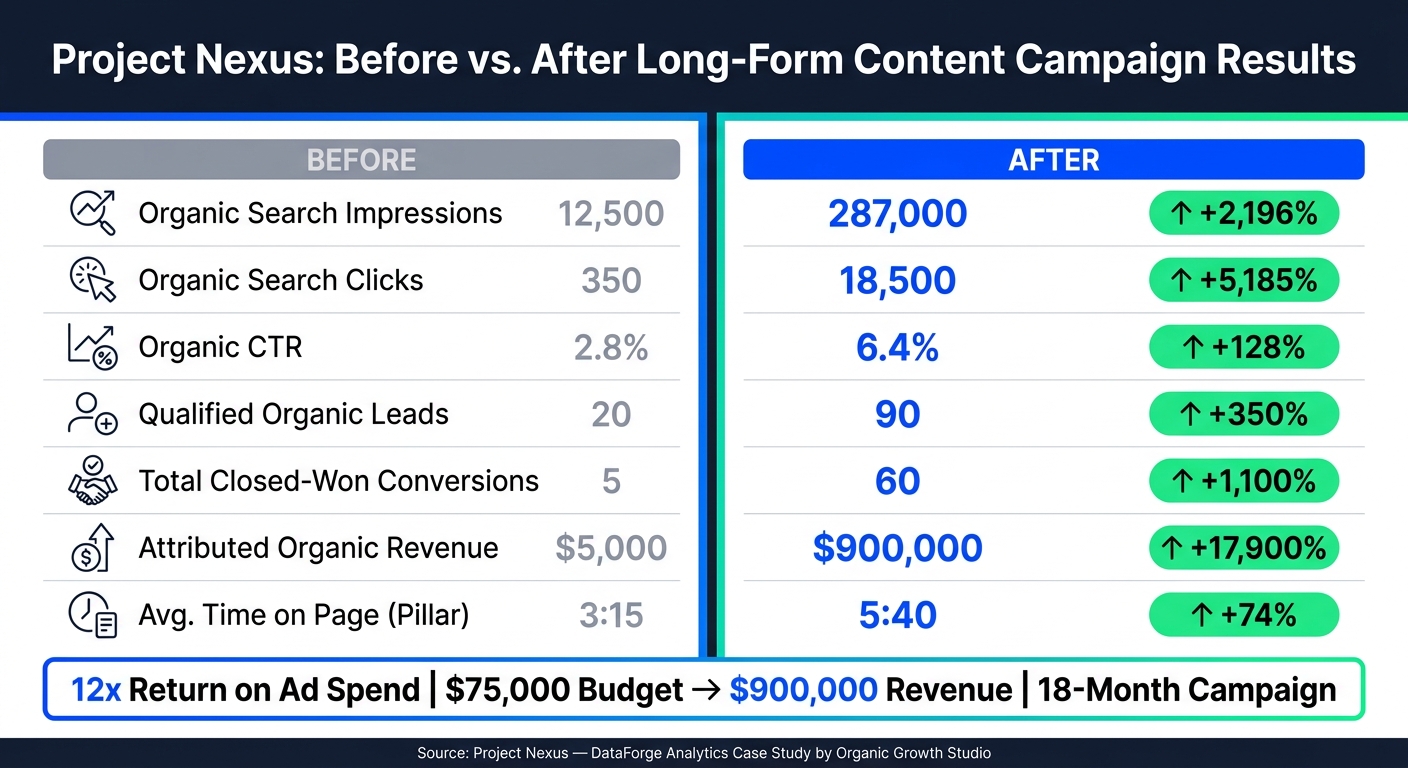
Before vs. After: Long-Form Content Campaign Results (Project Nexus)
Traffic and Search Visibility Numbers
Project Nexus, spearheaded by Mateo Salazar at Organic Growth Studio for the B2B SaaS client DataForge Analytics, delivered some eye-popping results. Over 18 months, organic search impressions skyrocketed by 2,196%, leaping from 12,500 to 287,000. Organic search clicks surged by 5,185%, growing from 350 to 18,500, while the organic click-through rate (CTR) climbed from 2.8% to 6.4%, an improvement of 128%. These achievements were driven by creating in-depth, high-intent guides ranging from 2,000 to 3,500 words.
Beyond traffic, these guides also dominated niche keyword spaces.
“Our guide titled ‘Leveraging AI for Predictive Maintenance in Cold Chain Logistics’ (a comprehensive 3,200-word guide) quickly ranked for dozens of niche keywords that competitors weren’t even touching. It generated over 15,000 organic impressions monthly by its third month.” – Mateo Salazar, Senior Digital Strategist, Apex Innovations
User Engagement and Behavior
The influx of traffic also brought a noticeable shift in user behavior. For pillar content, the average time on page jumped from 3 minutes 15 seconds to 5 minutes 40 seconds – a 74% increase. Additionally, bounce rates declined as users explored more pages, thanks to strategic internal linking.
Conversions saw a dramatic upswing as well. Daniel Martin, Senior Digital Marketing Strategist for the Atlanta B2B SaaS Connect campaign, noted that longer, solution-oriented articles (1,500+ words) converted at nearly 2.5 times the rate of shorter, feature-focused pages. For DataForge Analytics, closed-won deals from organic leads expanded from 5 to 60 – a 1,100% increase – resulting in $900,000 in organic revenue from a modest $75,000 campaign budget, yielding a 12x return on ad spend.
Before and After Comparison
The transformation in key performance metrics highlights the campaign’s success:
| Metric | Before Campaign | After Campaign | Change |
|---|---|---|---|
| Organic Search Impressions | 12,500 | 287,000 | +2,196% |
| Organic Search Clicks | 350 | 18,500 | +5,185% |
| Organic CTR | 2.8% | 6.4% | +128% |
| Qualified Organic Leads | 20 | 90 | +350% |
| Total Closed-Won Conversions | 5 | 60 | +1,100% |
| Attributed Organic Revenue | $5,000 | $900,000 | +17,900% |
| Avg. Time on Page (Pillar) | 3:15 | 5:40 | +74% |
These results underscore how focusing on user intent and pairing it with strategic promotion can drive not just visibility but also meaningful revenue growth.

Key Takeaways and Lessons Learned
What Worked Best
The success of Project Nexus didn’t come from simply producing more content – it came from creating in-depth, comprehensive pieces. Guides ranging from 2,000 to 3,500 words consistently outperformed shorter articles because they fully addressed users’ questions. As Martial Notarangelo, Founder of Authority Specialist, aptly said:
“Word count is a byproduct of depth, not a target – use the ‘Depth-First Drafting’ principle to write long naturally.”
This depth was paired with a strategic approach to internal linking and a semantic cluster structure. Each long-form guide acted as a central hub, connecting 8–12 shorter, related pages. This structure created a compounding authority effect, helping rankings improve over time. Community engagement on platforms like Reddit and LinkedIn also played a pivotal role, driving high-intent referral traffic – without spending a dime on paid advertising.
Strategies Worth Repeating
Several strategies from Project Nexus stand out as worth replicating in future campaigns:
- Chunk Sovereignty: Structuring sections so they function as standalone answers proved effective for securing AI overview mentions and featured snippets.
- Downloadable Assets: Adding resources like checklists and frameworks turned passive readers into leads. Campaign data suggests this tactic can boost free trial sign-ups by 7%.
- Content Refreshes: Regularly updating existing guides led to an average organic traffic increase of 110%, making it one of the most impactful post-campaign activities.
These content-focused strategies were further strengthened by exceptional design execution.
Visual Soldiers' Helps Brands Build Better Content Experiences
The creative agency Visual Soldiers plays a key role in elevating campaign’s performance. Their expertise in UX/UI design, custom web development, and ADA compliance ensure that the long-form guides are not only informative but also optimized for every screen size. For instance, mobile optimization alone can increase conversion rates from 1.2% to 3.5% in similar B2B campaigns. This technical edge directly impacts traffic and engagement.
Beyond technical improvements, Visual Soldiers enhances the campaign’s brand presence. Their work in brand strategy and visual identity ensures content feels cohesive and credible – more than just a collection of articles, it became a unified voice. Joel Darby, COO of GoValidate, reflected on his experience with the agency:
“Visual Soldiers was a great partner for our design needs. Their fractional model gave us on demand access to a talented team without the overhead of hiring in house.” – Joel Darby, COO, GoValidate
The combination of thoughtful content strategy and top-tier design execution makes projects a standout success.
Turn Great Content Into a Better Digital Experience
Visual Soldiers helps brands transform complex content into clear, engaging digital experiences through brand strategy, UX/UI design, and custom web development. Ready to build a website that works harder for your content?
Let’s Build Something BetterConclusion: The Case for Long-Form Content
Project Nexus demonstrates what’s possible when depth, strategy, and design come together. The results speak for themselves: a 5,185% jump in organic clicks, 12x return on ad spend (ROAS), and revenue skyrocketing from $5,000 to $900,000.
Beyond these impressive numbers, other examples highlight how effective this approach can be. A fashion retailer in San Antonio saw their monthly visitors grow from 1,300 to over 100,700 – an 8,200% increase in just eight months – by turning thin blog posts into a robust topic cluster framework with AI-enhanced summaries. Similarly, Peach State Professionals boosted their monthly leads by 333% by creating hyper-local, long-form guides tailored to Atlanta-specific topics. It’s clear: depth fosters trust, and trust drives long-term growth.
As Mateo Salazar, Senior Digital Strategist at Organic Growth Studio, explains:
“Organic growth isn’t just a buzzword; it’s the bedrock… the true gold lies in cultivating an audience that finds you naturally, trusts your voice, and champions your brand.”
This perspective underscores the importance of content strategies that focus on depth and user needs.
In 2026, long-form content continues to prove its value. A well-researched guide doesn’t just rank for multiple keywords – it attracts backlinks, fuels social media, and delivers leads long after its publication. Its impact is enduring.
At Visual Soldiers, we blend strategic insight with creative design to craft content that delivers real results. The journey from initial challenges to impressive outcomes shows just how powerful long-form content can be for achieving sustainable growth.
FAQs
When selecting BOFU keywords, it’s all about targeting terms that indicate a strong intent to purchase. Look for phrases related to comparisons, pricing, reviews, or specific product categories. These are the kinds of searches people make when they’re close to making a decision.
Don’t just chase high search volumes or focus solely on what your competitors rank for. Instead, align your keywords with key decision-making moments. For example, terms like “[product] pricing” or “[product] vs. [competitor]” can be incredibly powerful. These keywords address potential objections and highlight what makes your offering stand out.
A pillar page for a topic cluster is usually between 3,000 and 5,000 words. Its purpose is to give a broad overview of the main topic while briefly touching on related subtopics. The idea isn’t to cover every detail but to create a central, authoritative resource.
Think of it as a hub that connects all the subtopics – helping both readers and search engines understand the structure of your content. Search engines value clear topical organization and intent, so this approach aligns well with their priorities. For deeper exploration of any subtopic, use cluster pages that link back to the pillar page. This setup keeps everything organized and easy to navigate.
To make your content stand out in AI-generated overviews or tools like ChatGPT, focus on clarity and structure rather than word count. Here’s how you can achieve that:
- Use a TL;DR block: Start with a short summary highlighting the main points of your content. This helps AI extract key information quickly.
- Write question-based headings: Frame headings as questions and provide straightforward answers. This makes it easier for AI to process and deliver relevant results.
- Keep sections concise: Aim for sections that are between 120 and 180 words. This ensures the information remains digestible without overwhelming readers or AI systems.
- Add an FAQ section with schema markup: Structured FAQs improve visibility and help AI tools understand your content better.
If you’re looking for help with creating AI-friendly designs, companies like Visual Soldiers specialize in optimizing content for better AI visibility.

Visual Soldiers
Visual Soldiers is an Atlanta-based creative studio specializing in branding, design & digital experiences.