August 14, 2026
2026 Packaging Innovations: Minimalism Meets Sustainability
-
Visual Soldiers
- Design
- minute read
2026 Packaging Innovations: Minimalism Meets Sustainability
Quick Summary
By 2026, the most effective packaging will be designed to use less material, reduce shipping waste, and align with disposal systems that consumers can easily utilize. With stricter regulations in the U.S. and increasing consumer awareness, the demand for sustainable packaging is growing, as 82% of shoppers express willingness to pay up to 10% more for packaging that produces less waste. The article evaluates five different packaging options using four straightforward criteria: solid bars and naked packaging, refill systems, mono-material and fiber-based packs, and right-sized e-commerce solutions. These options are being assessed for their ability to meet the demands of sustainability and efficiency in the packaging industry.
The short answer: in 2026, the best packaging uses less material, ships with less waste, and matches disposal systems people can actually use. U.S. rules are tighter, proof matters more, and shoppers are paying attention – 82% say they would pay up to 10% more for packaging with a lower waste profile.
If I boil this down, the article compares five packaging options against four simple tests:
- Solid bars and naked packaging
- Refill systems
- Mono-material and fiber-based packs
- Right-sized e-commerce boxes
- Compostable formats
And it measures each one by:
- Material reduction
- End-of-life fit in U.S. recycling or compost systems
- Shipping efficiency
- Clear disposal guidance
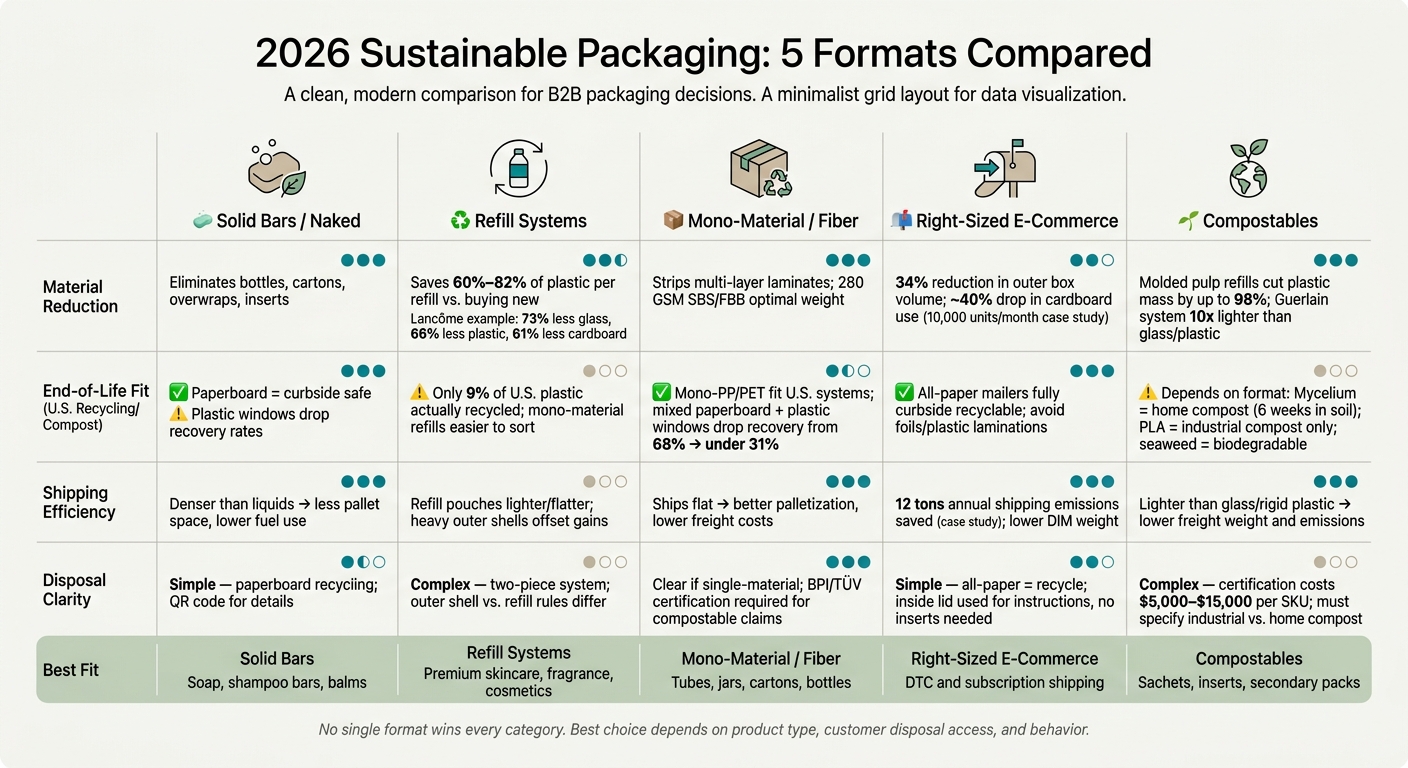
Here’s the main point: no single format wins every time. Solid bars cut a lot of packaging. Refills can save 60% to 82% of plastic per refill in some beauty lines. Right-sized shipping boxes cut empty space and, in one case, reduced outer box volume by 34%. Compostables can help, but only when compost access and certification are in place.
2026 Sustainable Packaging: 5 Formats Compared Across 4 Key Criteria
The 10 Sustainable Packaging Trends Defining 2026
Quick Comparison
| Packaging type | Main upside | Main limit | Best fit |
|---|---|---|---|
| Solid bars / naked | Very low pack use; lower shipping weight | Less product protection | Soap, shampoo bars, balms |
| Refill systems | Lower waste over repeat use | Higher upfront pack cost; depends on user habits | Skincare, fragrance, cosmetics |
| Mono-material / fiber | Simpler recycling path | Fewer barrier and finish options | Tubes, jars, cartons, bottles |
| Right-sized e-commerce | Less board, less DIM weight, less filler | Needs SKU-by-SKU box planning | DTC and subscription shipping |
| Compostables | Good for inserts, trays, and some single-use packs | Compost access is limited; certification can cost $5,000 to $15,000 per SKU | Sachets, inserts, secondary packs |
Bottom line: a clean look alone does not fix waste. I’d judge packaging by what happens after use – whether the customer can refill it, recycle it, or compost it without confusion.
1. Solid Bars and Naked Packaging
Material Reduction
When a formula doesn’t need water, the pack can get a lot smaller.
“Compared to liquid formulations, stick and solid formats typically require less protection. Also, fewer complex delivery systems are necessary, since the product is often applied directly.” – Stephen Corsi, Vice President Packaging Development, Innovative Beauty Group
Solid formats reduce packaging and can remove the need for bottles, cartons, overwraps, and inserts. That’s a big shift, especially for products that used to come with layer after layer of material.
Paper-based mono-material packaging is also starting to show up more often as a primary container for solid products like soap, shampoo bars, and balms. In 2026, French brand Wafe Care launched its Stick Anti-Frottements Naturel using Quadpack‘s 30g Multi Stick, a mono-material PP panstick with a matte finish made to be fully recyclable.
End-of-Life Fit
A smaller pack helps, but only if what’s left can move through U.S. recovery systems.
For solid bars, paperboard is still the safest bet for a secondary pack in U.S. curbside programs. Add plastic windows or metallic foils, though, and recovery rates can drop fast.
Compostability claims need proof too. In the U.S., ASTM D6400 is the main standard used to check those claims. Seaweed and mushroom wraps are part of that conversation, but they’re still a niche option.
Shipping Efficiency
Taking out water weight is one of the most direct ways to lower shipping emissions. Solid formats are denser than liquids, which means less pallet space, lower fuel use, and less dimensional weight during transport.
Brand Communication
Less surface area means less room to explain yourself. So every design choice has to pull its weight.
Brands that use naked or lightly wrapped formats often lean on texture, typography, and tactile finishes to do more of the talking. Soft-touch coatings, ribbing, and textured paperboard can help a pack feel distinct even when graphics are minimal.
A QR code can handle ingredients and instructions without crowding the pack.
When a product still needs a container, refill systems push that same low-waste approach even further.

2. Refillable and Reuse Systems
Material Reduction
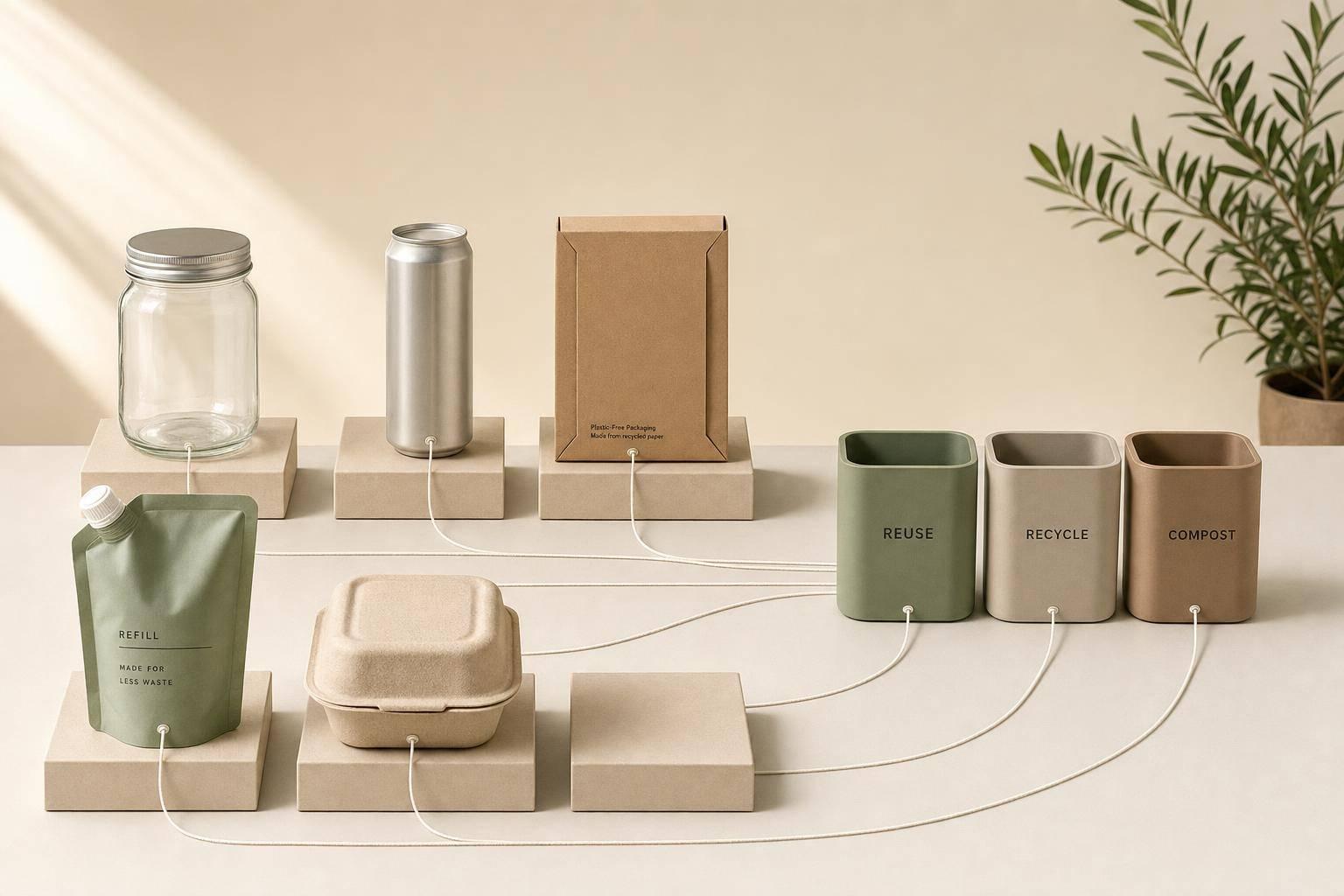
When a product still needs a container, refill systems push low-waste thinking past naked packaging. The idea is simple: keep the durable outer pack and replace only what’s inside. Reuse systems go further. The same container is sent back, cleaned, and put back into use.
Across major beauty portfolios, consumers can save between 60% and 82% of plastic per refill compared with buying a new full-size product each time. Lancôme‘s La Vie Est Belle Elixir 100ml refill saves 73% of glass, 66% of plastic, and 61% of cardboard compared with purchasing two standard 50ml bottles.
There is a catch. Those savings only work if people keep refilling. And refill packs often need more parts than a one-piece container, which means the first pack can carry a higher material load and carbon footprint than a standard single-use option. So the issue isn’t just how much material gets cut. It’s also about whether the system can be recovered cleanly at the end.
End-of-Life Fit
This is where refill systems can get messy. Mono-material packs, such as all-PP or all-PE, are easier for U.S. sorters to spot and process. Multi-material packs are more likely to be rejected.
The outer shell plays by a different set of rules. Glass and aluminum outers fit more cleanly into standard U.S. recycling streams, while post-consumer recycled plastic outer shells depend on the resin code. And here’s the hard part: only about 9% of plastic in the U.S. is actually recycled, so a “recyclable” label doesn’t mean the pack will be recovered in practice.
Shipping Efficiency
Refill pouches and pods are lighter and flatter than rigid bottles, which can cut freight weight. That’s a clear plus. But the durable outer shell can eat into those gains, especially when it’s made from heavy-wall glass, thick acrylic, or metal.
Direct-to-consumer pouches or pods tend to ship most efficiently because the refill is light and flat-packable. In-store refill stations bring more operating complexity for retailers, and mail-back programs add return-shipping weight and emissions.
Brand Communication
Refillable systems create a design problem that single-use packs don’t. You’re not just designing one product anymore. You’re designing two, and both need to feel like the same brand.
“We move from designing one product to designing two: the primary packaging and its refill – each must carry the brand’s codes and visual identity.” – Isabelle Lallemant, Global Marketing Director for Beauty, Silgan
The outer shell carries the brand’s codes and luxury look, while the refill needs to stay light, simple to swap, and lean on material use. The refill label is the right place for swap and return instructions. That split between brand shell and refill sets up the next step: simplifying materials when closed refill loops aren’t workable.
When refill loops are not practical, material simplification becomes the next lever.
3. Mono-Material and Fiber-Based Packaging
When refill loops don’t make sense, the next step is simple: make the pack simpler.
Material Reduction
Mono-material formats strip out multi-layer laminates, coatings, and plastic windows. Fiber-based formats lean on structural stress modeling to trim board thickness only where the pack can safely handle it. The result is a pack that looks cleaner, uses less material, and still does its job.
For fiber-based cartons, 280 GSM SBS (Solid Bleached Sulfate) or FBB (Folding Boxboard) hits a practical middle ground. It gives the pack a premium hand-feel without the extra fiber use that comes with heavier 320–400 GSM boards.
End-of-Life Fit
Mono-PP and Mono-PET fit current U.S. recycling systems more neatly than multi-layer packs. By contrast, mixed paperboard with heavy plastic windows can drag recovery rates from 68% to under 31%.
Brands that want a fiber-first option can look at molded pulp. It offers a lower-complexity route and can be biodegradable or compostable under certified conditions. That said, those terms aren’t interchangeable. Compostable materials usually need industrial composting facilities, not a backyard bin. And if a brand skips third-party certifications like BPI or TÜV, it can run into FTC issues under 16 CFR Part 260.
In July 2026, Dr. Loretta Skincare partnered with Diamond Packaging to launch color-coded folding cartons made with FSC-certified Neenah Folding Board. The board was manufactured using 100% wind energy in a zero-waste-to-landfill facility, pairing a high-end tactile look with carbon-neutral production.
Shipping Efficiency
Fiber-based cartons and mailer boxes ship flat, which helps with palletization and can cut freight costs.
“Minimalist packaging formats can provide tangible sustainable benefits… Lighter weight options can reduce fuel consumption and emissions associated with shipping.” – Moira Stein, Insights & Strategy, Berlin Packaging
Brand Communication
Take away plastic windows, metallic foils, and heavy laminates, and the pack has to speak in other ways. Texture, finish, and typography do the heavy lifting. Unbleached kraft paper tends to signal “natural” and “unprocessed.” Bold type and solid color blocks also make packs easier to read in e-commerce thumbnails.
There is a trade-off. High PCR content can push the substrate toward off-white or cream, and uncoated fiber substrates soak up ink, which dulls color vibrancy. NEST Fragrances found a way around that during the Christmas 2025 season. The brand used eight unique spot colors and sculptured embossing on 20pt Astrolite uncoated board for a diffuser carton, keeping a premium visual look intact.
When packs move from the shelf to shipment, size and structure matter just as much as the material itself.

4. Right-Sized E-Commerce Packaging
Once the primary pack is pared back, the next place to cut waste is the shipper. Oversized e-commerce boxes use more material than needed, increase DIM weight, and make the unboxing feel less polished. Right-sized packaging brings the same minimalist thinking to shipping.
Material Reduction
The idea is straightforward: build the box around the product, not the other way around. A snug fit – with no more than 1 inch of total clearance – can remove the need for bubble wrap, air pillows, and filler paper.
In April 2026, a beauty brand shipping 10,000 units per month reviewed its product dimensions and switched from one generic box size to three custom-sized Regular Slotted Containers (RSCs). That change led to a 34% reduction in outer box volume and a nearly 40% drop in cardboard consumption.
That’s minimalism in transit: less empty space, less board, less waste. It also cuts DIM weight and helps improve pallet density.
Shipping Efficiency
Smaller boxes also lower freight costs. The same brand reduced annual shipping emissions by an estimated 12 tons after moving to right-sized RSCs. Tear-strip openings on mailer boxes remove the need for plastic adhesive tape and make the unboxing feel cleaner for the customer.
End-of-Life Fit
Stick with all-paper mailers and cartons with no windows, foils, or plastic laminations. If a brand wants a more premium finish, spot UV can replace hot foil stamping without hurting recyclability.
Brand Communication
The inside lid can do more than close the box. Brands can use it for storytelling or instructions, which removes the need for separate paper inserts. It’s a small move, but it cuts extra material and keeps the package tidy.
Simple structure can still signal premium quality. On the outside, bold typography and flat color blocks tend to work better than layered graphics when the product shows up as a small e-commerce thumbnail. Test the hero image at 300×300 pixels. If the brand name isn’t clear at that size, the design likely needs stronger contrast or simpler type.
When right-sizing still leaves material behind, the next step is figuring out what that material can become.
5. Next-Generation Compostable Packaging
When right-sizing still leaves you with some protective fill, compostable packaging is often the last lean move.
It tends to make the most sense where recycling systems are weak. But there’s a catch: compostable packs need tighter proof and much clearer disposal instructions than refill or mono-material options.
Material Reduction
The main change here is simple: replace bulky materials with molded forms and plant-based fibers. Molded pulp made from bagasse (sugarcane fiber) or bamboo can take the place of multi-part containers and foam inserts altogether. Mycelium, which is the root structure of mushrooms, can be grown into exact shapes that protect fragile products like glass bottles. That makes it a home-compostable stand-in for EPS or EVA foam. For single-use items such as sachets and sample packets, seaweed-based films can handle moisture and oxygen barriers that plastic laminates used to manage, without leaving microplastic residue.
The leanest compostable packs also strip out extra boxes, inserts, and decorative layers that turn into trash the moment the package is opened.
Some molded pulp refill systems have cut plastic mass by up to 98% compared with standard rigid containers. Guerlain’s molded pulp refill system is a good example. It weighs 10 times less than a regular glass or plastic version.
Shipping Efficiency
That lower weight adds up fast at scale. Molded pulp and plant-fiber formats are lighter than glass, rigid plastic, or standard compostable plastics. In plain terms, that means less freight weight and lower carbon emissions per shipment.
End-of-Life Fit
Not every compostable material breaks down in the same way. That difference matters, especially for labeling. The disposal route has to match the material’s actual end-of-life path.
| Material | End-of-Life Option | Best Use Case |
|---|---|---|
| Mushroom (Mycelium) | Home compostable | Rigid outer packaging, protective inserts |
| Seaweed-based films | Biodegradable (no microplastics) | Single-use sachets, sample packets, wraps |
| Molded Pulp | 100% biodegradable | Trays, inserts, structural boxes |
| PLA Bioplastics | Industrial compostable | Jars, caps, clear windows |
Mycelium can break down in as little as six weeks in soil. PLA is a different story. It needs the heat and microbial conditions found in an industrial composting facility.
Brands also need third-party certification to back up compostable claims under FTC rules. That usually means BPI or ASTM D6400 for industrial composting, and TÜV OK Compost HOME for home disposal. Certification costs range from $5,000 to $15,000 as a one-time fee per SKU.
Once the disposal path is clear, the next step is making sure the pack still looks restrained.
Brand Communication
Compostable materials like molded pulp and textured kraft already have a built-in look and feel: raw, tactile, and low-finish. Brands can lean on that surface instead of adding extra decorative layers.
A QR code can handle disposal steps and certification details, which helps keep the package clean and uncluttered.




Trade-Offs, Pros and Cons
Minimal packaging cuts waste. But there’s no perfect format here. Each option comes with its own mix of cost, product protection, and end-of-life limits. In plain English: every format helps with one part of the waste problem, but none fixes the whole thing.
Refillable systems show this split pretty clearly. The durable outer pack can cost 2–4x more upfront than standard packaging. And the payoff depends on behavior, not just materials. If people don’t stick with refills, the waste savings can fall apart fast. That’s why convenience and pack design matter just as much as the sustainability pitch.
Compostables run into a different problem in the U.S. market. Industrial composting access is still limited. So even if the material sounds good on paper, the end-of-life case gets weak if consumers don’t have somewhere to send it.
The table below sums up the main trade-offs.
| Packaging Type | Key Benefit | Main Drawback | Best Product Categories |
|---|---|---|---|
| Solid Bars / Naked | Eliminates plastic waste; lower shipping weight | Limited barrier protection | Soaps, shampoo bars, concentrated cleansers |
| Refillable Systems | Supports repeat purchases; significant waste reduction over time | High upfront cost; requires consumer commitment | Premium skincare, fragrance, color cosmetics |
| Mono-Material (All-PP/PE) | Highly recyclable; simpler supply chain | Limited barrier properties; fewer decoration options | Tubes, jars, and bottles for body care and haircare |
| Right-Sized E-Commerce Packaging | Reduces shipping emissions; lowers material use | Requires precise engineering for each SKU size | DTC skincare, subscription supplements |
| Compostables | Natural perception; end-of-life circularity | Depends on industrial facilities; high certification costs | Single-use sachets, secondary packaging, protective inserts |
One issue shows up across almost all five formats: brand perception vs. production quality. A study of 1,300 packages found that simpler design can increase perceived price for branded products, but that same simplicity may look cheap or generic for store brands or value lines.
That puts more pressure on execution. On a minimal pack, details like precise embossing, controlled finishes, and clean typography do more work than they would on a louder design. The trick is to keep the pack polished without stuffing the label with certification marks and disposal instructions.
Ready to rethink what your packaging says about your brand?
Sustainable packaging should work harder than simply looking the part. Visual Soldiers helps brands create packaging experiences that balance smart material choices, standout design, and a brand presence customers remember.
Start A ProjectConclusion
The trade-offs lead to a pretty plain answer: fit matters more than style. No format comes out on top in every category in 2026. The right pick depends on the product, the disposal options people can get to, and how much behavior change the system asks of them. When you stack each option against the four criteria in this article – material reduction, recycling or composting fit, shipping efficiency, and disposal clarity – every format does some things well and misses on others.
A minimalist look is not a sustainability strategy. The rule is simpler than that: choose the format that can move through the infrastructure your customer can actually use.
Put even more plainly, the best format is the one customers can use and dispose of the right way. A refillable serum system makes sense for a loyal prestige skincare buyer with easy refill access. Compostables only work where composting access exists.
Minimalism shapes the pack; sustainability depends on the system around it.
FAQs
There’s no one-size-fits-all packaging choice. The right option depends on your product type, what the formula needs, and your sustainability goals.
For air-sensitive formulas, airless packaging or dropper bottles are often a smart fit. Thick creams and balms usually work better in jars or sticks. If sustainability is your main focus, go with mono-material packaging like all-PP or all-PE, and use recycled paperboard for secondary packaging.
Check for third-party certifications, not fuzzy claims about the planet. If a package is said to be recyclable, labels like How2Recycle can show how it should be handled in U.S. municipal programs.
For compostable items, look for names such as:
- BPI
- ASTM D6400
- TUV OK Compost
- DIN CERTCO
It also helps to ask suppliers for proof. That can include chain-of-custody papers or lot-specific testing. Those records back up the claim and can help you steer clear of greenwashing.
They’re worth the extra cost when they support a long-term plan that improves unit economics over time. Durable refill systems can cost 50% to 150% more upfront, but refill costs may fall by 60% to 70%.
They tend to work best when the refill process feels simple and the savings are obvious. If the refill is clearly cheaper than buying the original again, the container starts to do more than hold the product. It becomes a durable branded asset that helps build loyalty and repeat purchases.

Visual Soldiers
Visual Soldiers is an Atlanta-based creative studio specializing in branding, design & digital experiences.