
5 Tools for Competitor Audience Research
Want to understand your competitors’ audiences better? These five tools can help you analyze where competitors’ audiences spend their time, what content resonates with them, and how to refine your marketing strategies. From niche audience insights to social media engagement tracking, these tools provide actionable data to help you stand out.
Key Tools for Competitor Audience Research:
- SparkToro: Identifies where competitors’ audiences engage online – like podcasts, subreddits, and social media. Offers an Affinity Score to measure relevance.
- Similarweb: Tracks web traffic, audience demographics, and browsing behaviors. Includes audience overlap analysis for up to five competitors.
- GWI: Surveys 18 million people annually for deep psychographic insights, covering motivations, interests, and global trends.
- Semrush One2Target: Provides demographic, socioeconomic, and behavior data for competitor audiences, including geographic insights.
- Sprout Social: Tracks social media engagement, sentiment analysis, and share of voice across platforms.
Quick Comparison:
| Tool | Key Focus | Starting Price | Best For |
|---|---|---|---|
| SparkToro | Niche audience insights | $50/month | Finding influencers and affinities |
| Similarweb | Traffic & journey data | $125/month | Web traffic and competitor overlap |
| GWI | Psychographics | Custom pricing | Deep consumer behavior analysis |
| Semrush | Audience demographics | $139.95/month | SEO, PPC, and audience targeting |
| Sprout Social | Social listening | $199/month | Social media sentiment tracking |
Each tool excels in specific areas, so the right choice depends on your goals. Whether you’re identifying untapped audience segments, refining ad targeting, or tracking competitor trends, these tools can give you a competitive edge.
1. SparkToro
Audience insights depth
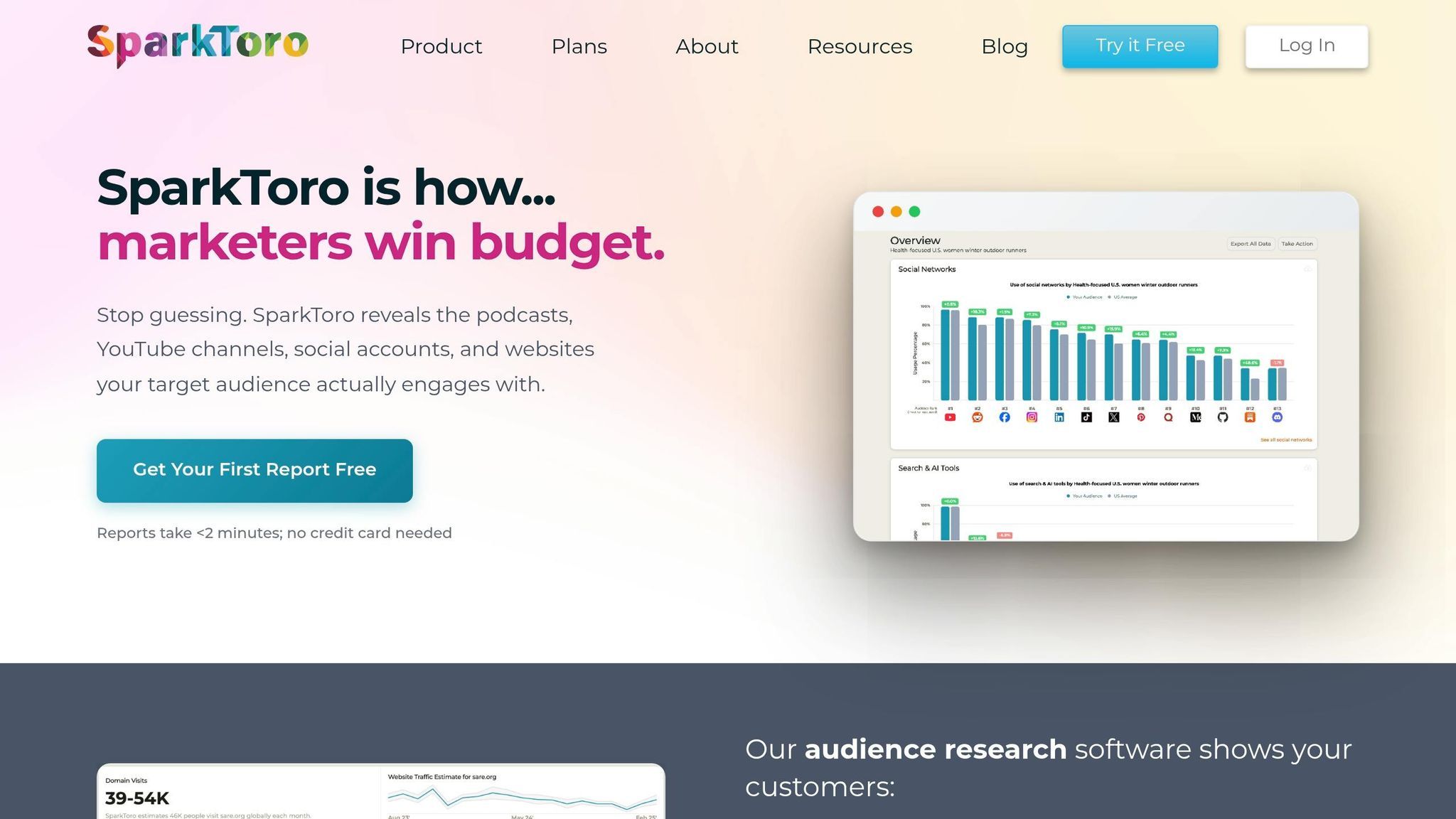
SparkToro provides a window into where your competitors’ audiences spend their time online. This includes platforms like podcasts, YouTube channels, Subreddits, and social media profiles. By analyzing around 100 million English-language search results and leveraging clickstream data from millions of devices, the platform builds a detailed picture of audience behavior.
The tool highlights trending keywords from the last 90 days, common questions your audience searches on Google, the AI tools they use, and demographic details like education levels, job titles, and skills. Each insight is paired with an Affinity Score (ranging from 1 to 100), which measures how relevant that data is to your target audience. As Rand Fishkin, SparkToro’s co-founder, puts it:
"SparkToro V2 isn't 'what searches are related to each other?' but instead, literally 'what searches are performed by the same group of people?'".
These insights provide actionable data to guide audience-focused strategies.
Use cases for audience research
SparkToro shines when it comes to identifying niche opportunities. It helps uncover smaller, more approachable publications, podcasts, and influencers that might fly under the radar of mainstream marketing efforts. Its “Related Questions” and “Trending Keywords” features enable you to create content tailored to audience needs, often before competitors pick up on emerging trends. As Ross Simmonds, Founder and CEO of Foundation Inc., explains:
“SparkToro has helped us close and retain some of the fastest growing SaaS brands in the world”.
The platform also improves ad targeting by pinpointing the most relevant social networks, including LinkedIn, Reddit, and GitHub. This allows for smarter allocation of ad budgets. Justin Adelson, Founder of Perfect Pixel Marketing, shared:
“Leveraging SparkToro’s data helped me acquire new leads through Facebook ads at 27% of the average cost per lead!”.
With this tool, you can uncover overlooked market opportunities and refine your marketing approach.
Pricing and accessibility
SparkToro offers a free plan with up to 5 monthly searches. Paid plans start at $38/month (billed annually) for the Personal tier, which includes 50 reports per month. The Business plan costs $112/month annually and provides 500 reports and access for up to 10 users. For larger teams, the Agency plan is priced at $225/month annually, offering unlimited reports and 100 user seats. Discounts are available for educational and nonprofit organizations.
The platform is flexible with its pricing structure. You can cancel, upgrade, or downgrade plans at any time, with pro-rated adjustments. Higher-tier plans unlock more data – while the Free plan shows only the “Top 5” results, the Agency plan expands this to the “Top 300”. Business and Agency subscribers also gain access to additional features like email and social contact data for sources in their lists and the “Take Action” AI tool, which translates research into ready-to-use marketing tasks.
Integration with marketing strategies
SparkToro integrates seamlessly with tools like Hunter.io to pull contact data and also allows CSV uploads of at least 50 keywords or websites for custom audience analysis. Rob Bonham, Digital Marketing Success Manager at Milestone, Inc., noted:
“SparkToro allowed us to see where our most relevant prospects live online. With that data we can now target content to include those social channels/pages/accounts where engagement is most likely”.
The platform addresses a common blind spot in analytics. For example, SparkToro’s “Dark Social” study revealed that platforms like TikTok, Slack, Discord, and WhatsApp contribute 100% of their traffic as “direct” in analytics, leaving no referral information. By uncovering these hidden traffic sources, SparkToro helps you see the full picture of how your competitors’ audiences discover content.
In short, SparkToro is a powerful tool for audience research, offering insights that can transform your marketing strategies and help you outpace competitors. Its ability to integrate with existing workflows makes it a key addition to any marketer’s toolkit.

2. Similarweb
Audience Insights Depth
Similarweb collects behavioral data from over 100 million websites and apps, offering a detailed look into competitor audience behavior. The platform breaks down visitor demographics, including gender, age (across six groups starting from 18), geographic location, and device preferences (desktop versus mobile) [2,24,27]. One standout feature is its audience overlap analysis, which reveals the percentage of shared visitors among up to five competitors. It also provides insights into cross-browsing habits by listing sites frequented by a competitor’s audience, complete with affinity scores. With access to up to 37 months of historical data, users can track trends and shifts over time [13,24]. These tools help businesses identify untapped segments within their market.
Use Cases for Audience Research
Similarweb supports market sizing and helps uncover growth opportunities. Its Audience Overlap tool allows businesses to calculate their total addressable market and pinpoint potential visitors who frequent competitors but haven’t yet discovered their site. Francesco Santoro, Data Strategist at IG Markets, highlighted its value:
"Similarweb gives us valuable insight into what our competitors are doing with their display ad strategy, who they are targeting, and with what messaging".
Companies like MGM Resorts and MandM Direct have used Similarweb to refine their strategies. MGM identified nine new partnerships that boosted revenue by 10% in just one year, while MandM Direct achieved an 8% year-over-year increase in new customer acquisition [2,25,26]. The platform also plays a role in improving user experience. By analyzing the mobile versus desktop traffic split among competitors, businesses can prioritize website updates. For instance, Group M (Poland) saw a 60% year-over-year increase in organic traffic after applying SEO strategies informed by Similarweb’s insights [2,25].
Pricing and Accessibility
Similarweb offers flexible pricing options, ranging from free trials to custom enterprise packages [13,26]. Smaller teams can opt for the “Similarweb for Entrepreneurs” plans, which are self-managed and can be canceled directly through the platform [30,31]. Larger organizations can explore tailored solutions like the Competitive Intel Suite, Strategic SEO Suite, and Ads Intel Suite. Advanced features – such as 37 months of historical data, AI Studio, and API integration – are available through consultations with the sales team [30,31]. Trusted by over 10,000 customers worldwide, Similarweb boasts a database containing over 5 billion keywords and 250 million display ads [25,30].
Integration with Marketing Strategies
Similarweb’s extensive data capabilities make it an integral part of broader marketing strategies. The platform integrates with tools like Snowflake and AWS, and it offers real-time and bulk APIs to streamline marketing workflows [30,31]. Covering more than 210 industries, it provides high-level benchmarking for traffic and channel performance. For example, Cappuccino Digital leveraged trend mapping during Black Friday to refine client strategies, achieving a 20% increase in sales. Its ability to track data across 190 countries and over 210 industries is particularly useful for businesses exploring regional expansion or new markets. Additionally, companies can use it to benchmark audience loyalty against industry averages, helping them evaluate and improve retention strategies [23,26,29]. Next, we’ll dive into another tool that offers distinct audience insights to enhance your competitive edge.
3. GWI
Audience Insights Depth
GWI takes a unique approach to audience research by collecting data directly from surveys instead of monitoring online behavior. Each year, the platform surveys over 18 million people, compiling insights across 250,000 data points from more than 50 markets. These range from basic demographics to deeper aspects like personal aspirations, cultural identity, and even political views.
For those analyzing competitors, GWI provides data on perceptions, engagement, and ownership for over 4,000 global brands. Its Crosstabs feature allows users to compare multiple data points side-by-side, making it easier to spot differences between their audience and competitors’ audiences. GWI also caters to specific industries with specialized datasets, such as GWI Gaming, GWI Sports, GWI Work (for B2B professionals), GWI Kids (targeting ages 8–15), and GWI USA, which dives into insights from all 50 states. To simplify the research process, the platform’s AI assistant, Agent Spark, enables users to query 15+ years of survey data using natural language, delivering insights instantly without requiring advanced data skills.
These comprehensive consumer profiles provide businesses with the tools they need to create targeted strategies.
Use Cases for Audience Research
GWI helps businesses uncover the motivations behind consumer behavior, making it a go-to tool for competitive benchmarking. For example, McCann Worldgroup emphasizes:
“We use GWI for every single pitch”.
Similarly, Sony has noted:
“Having used it for a number of years, this is my preferred source for global audience insight”.
The platform also identifies where competitor audiences are most active, enabling businesses to fine-tune their media spending and product features. When it comes to product development, GWI helps validate ideas by revealing which features resonate most with target audiences or what products they’re planning to purchase. To save time, the GWI Canvas tool automatically converts consumer insights into presentation-ready slides, eliminating the need for manual formatting.
GWI’s versatility makes it a valuable resource for both strategic planning and day-to-day marketing needs.
Pricing and Accessibility
GWI offers a flexible pricing model tailored to business needs, with custom quotes available via demo. Users can explore the platform through a free sign-up option before committing to a full subscription. This adaptability allows businesses to pay only for the datasets most relevant to their industry, such as GWI Gaming or GWI USA. Additionally, tools like Agent Spark make the platform user-friendly, even for those without technical expertise, enabling marketers to quickly test strategies and access insights without diving into complex data analysis.

4. Semrush One2Target
Audience Insights Depth
Semrush One2Target takes competitor audience research to another level by offering a detailed, data-driven analysis. It organizes its insights into four main dashboards: Demographics, Socioeconomics, Behavior, and Audience Overlap. These dashboards rely on third-party panel data and advanced AI algorithms to predict audience metrics at the domain level.
The Demographics dashboard breaks down audience details like age groups, gender distribution, and geographic locations (down to specific countries or regions). The Socioeconomics section dives deeper, revealing factors like household size, income brackets (low, middle, high), employment status (full-time, part-time, student, retired), and education levels. The Behavior dashboard focuses on audience interests, categorizing them into 13 sectors, including Fashion, Health, and Sports. It also tracks activity across 10 major social platforms and identifies whether users prefer desktop or mobile devices.
The Audience Overlap feature uses Venn diagrams to illustrate shared and unique visitors among up to five domains. This tool highlights opportunities like “Potential Audience” – users visiting competitors but not your site – and even uncovers other websites frequented by your target audience. You can analyze data across up to 20 countries or zoom in on specific U.S. states for more localized insights.
Use Cases for Audience Research
One2Target is incredibly useful for spotting gaps in the market. For instance, it can reveal age or gender groups that your competitors aren’t tapping into. A real-world example: In March 2024, Amazon had 645.6 million visitors, while Temu had 210.5 million. By the following year, Temu’s audience had more than doubled to 529.5 million, with its overlap with Amazon growing from 9.42% to 15.3%. This data highlights Temu’s rapid market expansion.
Regional analysis is another strength. Consider Australia: ASOS shared 15.17% of its audience (234,500 users) with Princess Polly, a local brand. Meanwhile, Princess Polly had a 23.49% overlap (290,900 users) with another domestic brand, Kookai, showcasing a strong preference for local labels. Such insights help businesses decide whether to focus on global branding or more localized campaigns.
The tool also identifies partnership opportunities. For example, an analysis revealed that Netflix and Sephora shared 3.2 million visitors in a single month – an indicator of potential for co-marketing efforts. The “Visited Domains” section can help you find non-competing websites with overlapping audiences, ideal for ad placements or collaborations.
Additional features include data on education levels, which can guide the tone and complexity of your content, and social media preferences, which help allocate resources to the platforms where your competitors’ audiences are most active. Device usage trends can inform decisions on whether to prioritize mobile-friendly designs or desktop-focused content.
Pricing and Accessibility
One2Target is part of the Semrush Traffic & Market Toolkit. New users can access a 7-day free trial of “Semrush One”, which includes One2Target. The tool’s user-friendly dashboards, complete with visual elements like Venn diagrams, make it easy to interpret complex data without needing advanced technical skills.
For those looking for even more specialized insights, the Audience Intelligence app is available separately in the Semrush App Center for $150 per month per report. Additionally, the tool allows users to organize competitor analyses into “Folders”, making it easier to monitor specific sets of competitors over time.
Next, we’ll take a closer look at how Sprout Social brings new dimensions to competitor audience research.
Audience Insights Depth
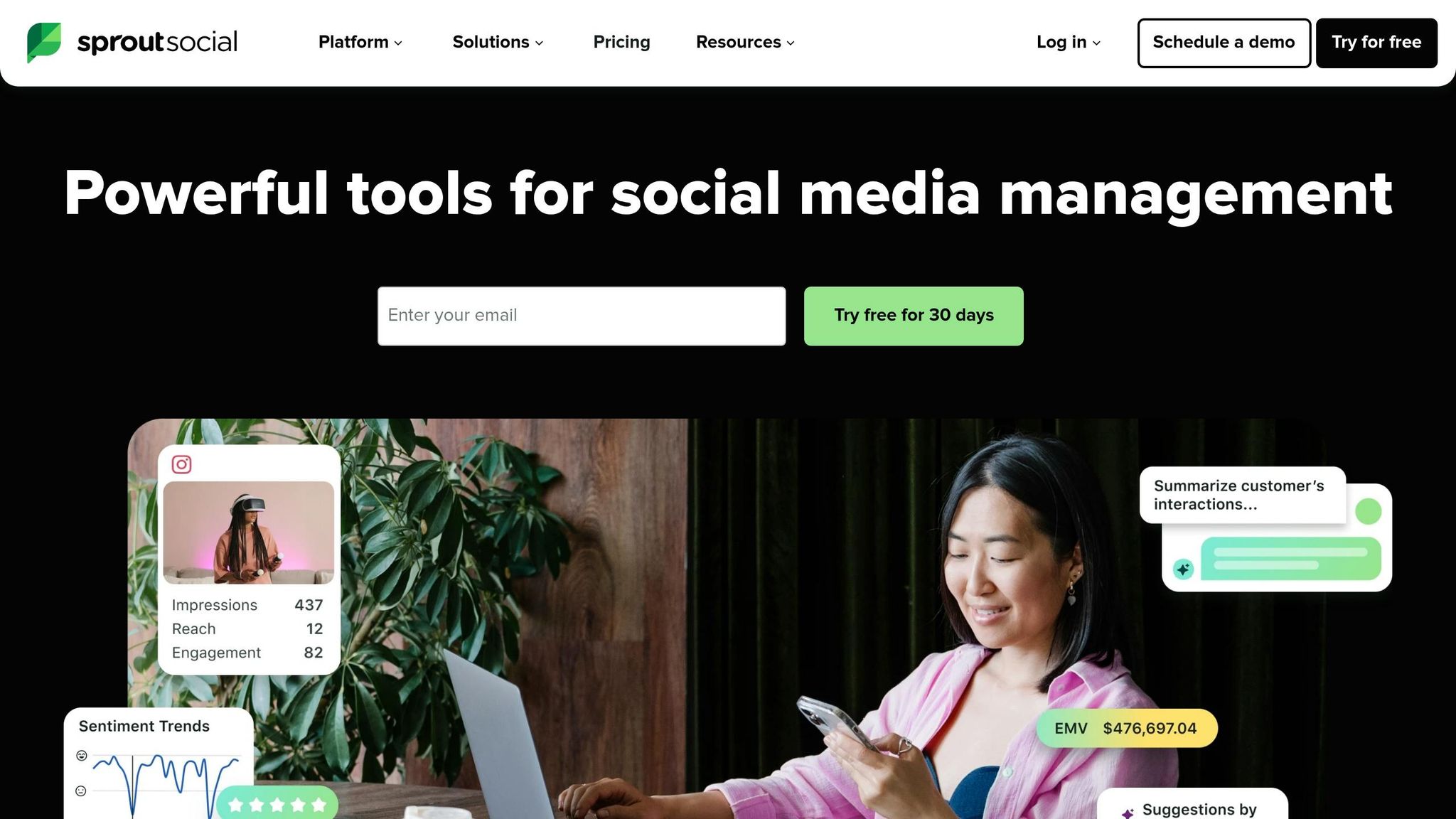
Sprout Social is built for tracking real-time conversations and engagement across major platforms like Facebook, Instagram, X (formerly Twitter), and LinkedIn. Its AI-powered Social Listening tool processes an impressive 50,000 posts per second and handles about 600 million messages daily.
The platform organizes insights into several categories to make data more actionable. Competitive Benchmarking allows you to compare metrics like follower growth, engagement rates, and post volume against up to 20 competitors. Consumer Research dives into audience demographics, breaking down details like age, gender, location, and device preferences of those engaging with competitors. To top it off, Sentiment Analysis uses AI to sort conversations by tone – positive, negative, or neutral – helping you better understand how audiences feel about specific topics or brands.
A standout feature is Trellis, an AI assistant that answers complex research questions in plain language, eliminating the need for manual report creation. Additionally, the platform identifies key influencers and industry leaders within competitor conversations, which can help you find potential brand advocates.
Use Cases for Audience Research
Sprout Social’s data depth directly supports strategic competitive analysis. One of its strengths is tracking share of voice (SOV) – a measure of your brand’s visibility compared to competitors across social platforms, forums, and review sites. For example, in 2023, Grammarly used Sprout’s Social Listening tools, discovering it held 71% of the SOV in its competitive space. This kind of insight highlights market dominance and identifies areas where your brand might need improvement.
“Listening not only helps us better understand what the conversations are about our brand in the digital space, it lets us make sure we’re dominating share of voice in our industry in a relevant, impactful and positive way.” – Kara Wenman, Digital Content Marketing Manager, James Hardie
Sentiment tracking is another valuable tool. For example, if a competitor launches a feature that receives negative feedback, you can identify unmet customer needs and adjust your approach accordingly. Sprout Social also provides network-specific performance reports, showing which types of content resonate with competitor audiences. This helps you spot gaps in your own content strategy.
A great real-world example is River Island, which used Sprout’s Listening tools in 2023 to monitor industry trends and measure its SOV against other fashion brands. This helped the company stay ahead in the fast-moving fashion sector.
Pricing and Accessibility
Sprout Social offers a 30-day free trial – no credit card required – making it easy to explore its features. For deeper insights, premium add-ons like Social Listening and Premium Analytics are available.
The platform also integrates seamlessly with CRM and BI systems, working well with tools like Slack and Salesforce.
Integration with Marketing Strategies
Sprout Social goes beyond data collection, turning raw numbers into actionable strategies. Its focus on real-time social engagement makes it a valuable resource not just for social media teams but also for product development, customer care, and sales. For example, it helps identify competitor gaps, aligning social strategies with broader company goals.
The platform also lets you use first-party CRM data as “seed lists” for Meta’s automated ad systems, helping algorithms target high-value customers. Bret Neuman, Head of Social & Video Media at Rover, shared how his team uses Sprout Social to analyze U.S. audience preferences and then shares those insights with European brand managers to test local market responses. This cross-regional approach shows how competitor audience research can scale across diverse markets.
Sprout Social’s competitive analysis tools also support market entry strategies by highlighting untapped opportunities and clarifying what sets your brand apart. With 93% of consumers saying brands need to stay in tune with online trends and 73% willing to switch to competitors if a brand doesn’t respond on social media, staying ahead of the curve is essential. These capabilities make Sprout Social a key player in today’s competitive landscape.




Google Ads Competitor Research Made Easy with Semrush
Tool Comparison Overview
Every tool in this lineup offers distinct advantages, so your choice depends on the type of audience data you need and how you intend to use it. SparkToro is a standout for identifying the digital habits of niche audiences. Instead of focusing on broad demographics, it pinpoints where specific groups engage – like subreddits, podcasts, and YouTube channels. On the other hand, Similarweb processes an incredible 10 billion digital signals and 2 TB of data daily, providing insights into traffic patterns across 100 million websites. For psychographic data, GWI leads the way with its extensive consumer behavior study spanning over 50 global markets. Semrush One2Target is ideal for competitive analysis, offering detailed geographic breakdowns, including state-level audience distribution. Lastly, Sprout Social focuses on social media, using AI to analyze sentiment and track share of voice across platforms.
"Marketing without understanding your customers' motivations is like flipping a coin." – Jenna Kamal, Content Strategist, GWI
When it comes to pricing, SparkToro offers a budget-friendly starting point at $50/month, alongside a free plan with 5 searches per month. Similarweb starts at $125/month, while Semrush Pro plans begin at $139.95/month. Sprout Social is priced higher, with its Standard plan at $199/month and the Professional plan, which includes competitor reporting, at $299/month. GWI, however, uses custom enterprise pricing, requiring a demo to get a quote.
Integration options vary across tools. Semrush supports workflow automation through Zapier, while Sprout Social connects directly to major platforms like Facebook, Instagram, X, LinkedIn, TikTok, YouTube, and Pinterest. SparkToro offers an API and a “Take Action” feature to turn insights into actionable marketing tasks. Similarweb provides API access and browser extensions for real-time data collection.
Here’s a quick-reference table summarizing the key features of each tool:
| Tool | Primary Use Case | Audience Data Depth | Starting Price | Key Integration |
|---|---|---|---|---|
| SparkToro | Influencer discovery & niche targeting | High (Social footprint & behavior) | $50/month | API, CSV export, Take Action feature |
| Similarweb | Traffic benchmarking & journey mapping | High (Web traffic & browsing patterns) | $125/month | Browser extensions & API |
| GWI | Persona building & global psychographics | Very High (Attitudinal survey data) | Custom pricing | Media planning tools |
| Semrush One2Target | Competitor domain audience analysis | Medium-High (Demographics & interests) | $139.95/month | Integrated SEO/PPC suite |
| Sprout Social | Social listening & sentiment analysis | High (Engagement & brand mentions) | $199/month | Major social platform APIs |
This comparison simplifies the process of aligning tool features with your marketing needs. Whether your focus is on psychographics, web traffic, or social media engagement, there’s a tool here to match your goals.
Conclusion
Choosing the right competitor audience research tool boils down to your marketing goals and budget. If you’re working on a tight budget, SparkToro is a solid choice. With a starting price of $50/month and a free plan offering 5 searches per month, it excels at identifying the podcasts, social accounts, and niche communities your audience engages with – areas where traditional SEO tools often fall short. For businesses prioritizing traffic patterns and browsing behavior, Similarweb processes 10 billion digital signals daily, providing a wealth of actionable data.
For those needing detailed geographic insights or an all-in-one solution for SEO and PPC campaigns, Semrush One2Target is a great fit, starting at $139.95/month. Meanwhile, Sprout Social caters to brands focusing on social media strategy, with pricing starting at $199/month. If your organization requires deep psychographic data across over 50 markets, GWI offers custom enterprise pricing tailored to larger-scale needs.
“A startup can’t and shouldn’t spend time on marketing until they know who their audience is, who is already influencing them, and what content they’re interested in.”
– Vinny La Barbera, Founder & CEO, imFORZA
Your core research goals will ultimately guide your decision. If you’re targeting SEO performance and keyword analysis, Semrush delivers comprehensive data. For monitoring audience sentiment and brand perception on social platforms, Sprout Social offers real-time listening tools. And if you’re seeking insights into audience influencers – like podcasts, YouTube channels, or social accounts – SparkToro provides unmatched affinity data.
Many of these platforms provide free trials, making it easy to test before committing. For example, SparkToro generates reports in under two minutes without requiring a credit card, Semrush offers a 7-day trial, and Sprout Social includes a 30-day trial. Leverage these opportunities to refine your strategy and maintain a competitive edge.
Turn your brand into a competitive advantage
Book a strategy call and see how we build brands that scale, perform, and stand out.
Book a CallFAQs
When selecting a tool, it’s all about aligning it with your specific objective:
- Traffic analysis: SparkToro is great for discovering which websites, podcasts, and platforms your audience engages with most.
- Psychographics: SparkToro also provides insights into your audience’s demographics, interests, and motivations.
- Social listening: Tools like Mention or Hootsuite excel at tracking social media mentions and identifying trends.
Choosing the right tool depends on whether you’re focusing on traffic, audience behavior, or social media insights.
Competitor audience data can reveal helpful insights, but it’s not without flaws. Many tools pull from publicly available sources, which are often outdated or incomplete, leaving gaps in real-time accuracy. Additionally, surface-level analysis might overlook emerging competitors or miss deeper, underlying trends. For better accuracy, it’s essential to pair this data with continuous, detailed research and thoughtful analysis. This approach helps fill in the gaps and provides a clearer, more reliable picture.
Combining various competitor audience research tools is a smart way to uncover diverse insights. Each tool tends to specialize in specific areas – like SEO, PPC, social media, or content performance. By pulling data from multiple tools, you can piece together a broader picture of your competitors’ strategies across different channels. This approach not only enriches your analysis but also helps reduce redundancy in the data you’re working with.

Visual Soldiers
Visual Soldiers is an Atlanta-based creative studio specializing in branding, design & digital experiences.