Ultimate Guide to Social Media Design Trends
Social media design is evolving fast, and staying ahead is critical for standing out. In 2026, visuals are more interactive, dynamic, and audience-focused than ever. Here’s what you need to know:
- Bold Colors: Bright, vibrant palettes dominate, breaking monotony and grabbing attention.
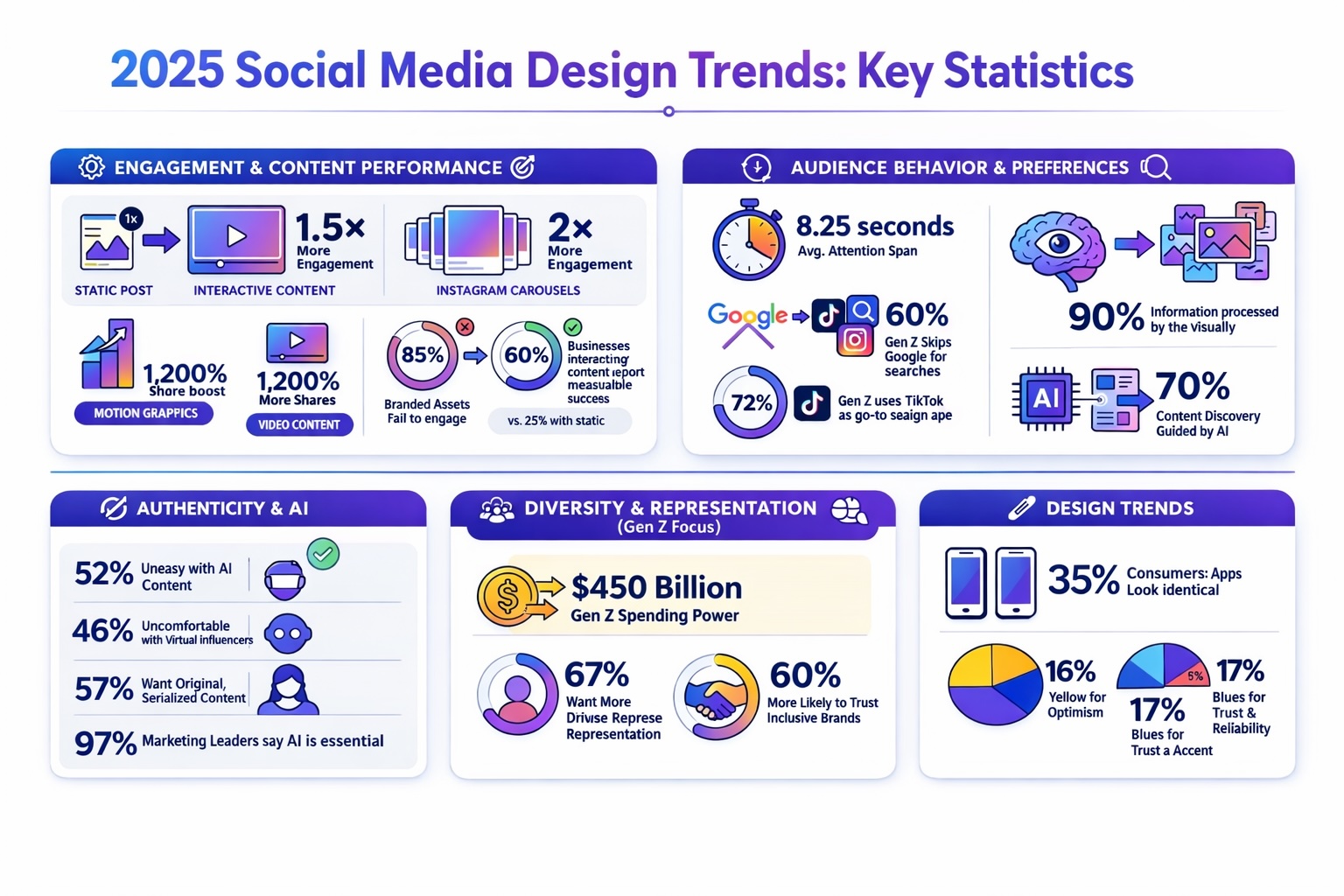
- Interactive Content: Features like polls, quizzes, and clickable elements drive 1.5× more engagement than static posts.
- Motion Graphics: Animated visuals, kinetic typography, and seamless transitions boost shares by 1,200%.
- Raw Content: Users prefer unpolished, relatable visuals over heavily edited campaigns.
- Diverse Representation: Reflecting audience diversity builds trust and loyalty.
- AI Integration: AI automates tasks, speeds up production, and personalizes content while leaving storytelling to humans.
Key Stats:
- 85% of branded assets fail to engage users.
- 70% of content discovery is guided by AI recommendations.
- 60% of Gen Z skips Google, using TikTok and Instagram for searches.
The future of social media design lies in creating visually striking, interactive, and relatable content while leveraging AI for efficiency. Focus on building connections with your audience through honest storytelling and inclusive visuals.
Bold and Bright Color Palettes
Social media feeds are jam-packed with content, making it tough for brands to stand out. That’s why vibrant, bold color palettes are taking over, pushing aside neutral tones and muted shades. These striking colors are designed to grab attention and spark emotional connections instantly. With 35% of consumers feeling that most digital apps look identical, brands are using bold hues to cut through the monotony, establish recognition, and create memorable impressions.
Why does this work? Because color communicates faster than words. In fact, 90% of the information processed by the human brain is visual. This means color-driven content can deliver messages far quicker than text-heavy designs. Many brands are embracing a style known as “minimaximalism”, which combines clean, simple layouts with vibrant, attention-grabbing colors. This approach ensures designs are eye-catching but not overwhelming.
How Color Affects User Behavior on Social Media
Colors don’t just look good – they influence how we feel and act. For example, 16% of logo designers in 2025 chose yellow to convey optimism and energy, while 17% leaned toward blues – from deep midnight to soft aquamarine – for a sense of trust and reliability. Red, used by 6% as an accent color, is perfect for creating urgency and making content memorable, though it works best in moderation.
Yellow tones radiate warmth and friendliness, making them a hit with younger audiences on platforms like TikTok and Instagram. On the other hand, blue shades evoke calmness and trust, which explains their popularity among tech and financial brands. As Gael Towey, Creative Director at Gael Towey & Co., explains:
"Color creates emotion, triggers memory, and gives sensation".
Some brands are also experimenting with monochromatic contrast, blending light and dark shades of the same color – like deep navy paired with soft aquamarine. This technique creates dynamic visuals that feel cohesive, helping brands maintain consistency while still standing out in crowded feeds. This understanding of color psychology has also fueled the rise of gradients and neon accents.
Some brands are also experimenting with monochromatic contrast, blending light and dark shades of the same color – like deep navy paired with soft aquamarine. This technique creates dynamic visuals that feel cohesive, helping brands maintain consistency while still standing out in crowded feeds. This understanding of color psychology has also fueled the rise of gradients and neon accents.
Using Gradients and Neon Effects
Gradients and neon accents are dominating social media design trends – but the trick is to use them wisely. Retro-futurism, a style that mixes 80s-inspired neon lights and metallic effects with sleek, modern layouts, has become especially popular on platforms like Instagram and TikTok. Instead of flooding entire designs with neon, smart designers are using neon accents – highlighting call-to-action buttons, borders, or key text – to make features pop without overwhelming the viewer.
To avoid the overly polished look of AI-generated imagery, designers are adding texture to gradients. This approach, inspired by 1940s Japanese risograph printing, brings a raw, authentic vibe that resonates with audiences craving unfiltered visuals. When creating gradients, using analogous colors (three colors next to each other on the color wheel) creates smooth, harmonious blends, while complementary colors (opposites on the wheel) deliver bold, high-energy contrasts.
The key takeaway? Be bold and expressive with your brand’s unique identity, but don’t forget to balance the technical details. Use plenty of white space to keep designs clean, and ensure there’s enough contrast between vibrant backgrounds and text for easy readability.
At Visual Soldiers, we’re all about tapping into these dynamic trends to craft social media designs that not only grab attention but also leave a lasting emotional impact.

Interactive and Immersive Content
Social media thrives on interaction. In fact, interactive posts generate 1.5× more engagement than static ones by encouraging users to click, swipe, and tap. With the average attention span on social media clocking in at just 8.25 seconds, brands need to grab attention fast and keep it. Interactive content does exactly that, turning passive viewers into active participants.
Gamification and Clickable Elements
Gamification transforms social media into an engaging experience. Features like polls, quizzes, contests, and clickable hotspots not only make content fun and competitive but also gather valuable insights while driving lead generation. Consider this: 60% of businesses using interactive content report measurable success, compared to just 25% relying on static posts.
A great example is Booking.com’s “Travel the Screen” campaign, which ran from May to June 2024. Partnering with Amazon’s Brand Innovation Lab, they created an interactive video tied to the movie The Idea of You. Viewers could click on hotspots to explore real travel destinations featured in the film. The results? The campaign reached 22.3 million unique users, with a 10% boost in aided brand awareness and a 9% improvement in brand opinion. As Jenn Grieger, Senior Manager of Marketing at Booking.com, explained:
"Interactive campaigns like this one invite audiences to explore, dream, and plan".
Another standout is Nespresso’s “Coffee Profiler Quiz.” By asking users about their taste preferences and brewing habits, the quiz helps customers find the perfect coffee blend while collecting valuable data.
Instagram carousels also deliver strong results, generating 2× more engagement than single-image posts. Each swipe acts as a small commitment that signals interest to platform algorithms. Similarly, clickable layers in videos and images shorten the path from inspiration to action, enabling users to shop, book, or learn more without leaving the app. And when you add motion elements, engagement climbs even higher.
Motion Graphics and Animated Typography
Motion graphics and animated typography bring static designs to life. Video content, for example, generates an incredible 1,200% more shares than text and images combined. Animated visuals enhance engagement and make ads more persuasive.
Micro-animations – like bouncing icons, fading text, or pulsing buttons – add personality to content without overwhelming viewers. Kinetic typography takes this a step further, animating text to jump, stretch, or pulse, reinforcing the message in a visually compelling way. These elements shine on platforms like TikTok and Instagram Reels, where short, dynamic videos dominate.
Seamless transitions and fluid loops help maintain attention. Techniques like liquid motion, where shapes morph and flow naturally, create a modern, tactile feel. Pairing these visuals with subtle sound effects, like clicks or whooshes, adds polish to the experience. And since most social videos are watched on mute, clear text overlays and captions ensure your message gets across, even without sound.
At Visual Soldiers, we create interactive and immersive content that goes beyond aesthetics. By inviting users to engage, explore, and act, we help brands turn attention into action, seamlessly integrating these dynamic visuals into a cohesive social media strategy.

Authenticity and Inclusive Storytelling
People are over the picture-perfect ads and posts. What they want now are brands that feel real. This shift from flawless advertising to honest storytelling isn’t just a passing fad – it’s a deep change in how audiences connect with content. Brands that show their imperfections and represent a range of voices earn trust and loyalty. It’s a move toward raw visuals and genuine narratives that resonate on a human level.
The Shift to Raw and Unfiltered Content
Audiences can spot fake content a mile away. In fact, 52% of social media users are uneasy when brands post AI-generated content without being upfront about it, and 46% feel uncomfortable with virtual influencers. People want content that feels human – the flaws, the unscripted moments, the behind-the-scenes glimpses that make it relatable. That’s why platforms like BeReal and TikTok have embraced a more casual, “messy” aesthetic.
Tameka Bazile, Associate Director of B2B Social and Content at Business Insider, explains:
"Audiences can feel when something wasn't made by a real person. They crave human tone, real experience, and the imperfections that make content relatable."
This demand for authenticity has pushed brands to ditch overly polished campaigns in favor of raw, unfiltered content. Instead of perfectly staged photoshoots, brands are sharing drafts, bloopers, and real-life moments. It’s working – 57% of audiences want to see original, serialized content from brands, and 43% of organizations are trying out new tones or personalities on social media to connect better.
Take GoPro’s June 2025 partnership with influencer Susi Vidal, for example. Known for her “Only Pans” cooking series, Vidal collaborated with GoPro to create a home-cooking video entirely shot on a GoPro HERO13 Black. The campaign highlighted the camera’s versatility beyond extreme sports while tapping into Vidal’s 4 million TikTok followers and her reputation for relatable, trustworthy content. It was a perfect blend of authenticity and creativity.
User-generated content (UGC) is another way brands are keeping it real. When customers share their own experiences, it feels genuine because it is. Featuring UGC not only cuts production costs but also builds community and showcases the people who already love your brand.
Inclusive Representation in Visual Design
Being authentic also means reflecting the diversity of your audience. Gen Z, with their $450 billion in global spending power, is especially vocal about this. 67% want to see more diverse representation in advertising and media, and 60% are more likely to trust a brand that shares their values on inclusivity.
True representation goes beyond token gestures. It’s about showing people with disabilities, celebrating different body types and skin tones, and featuring stories from various backgrounds. It also involves designing for accessibility – using high-contrast colors for visually impaired users, adding descriptive alt text, and ensuring captions are easy to read on mobile devices.
Kara Redman, CEO of Backroom, sums it up perfectly:
"As AI content goes up, our desire for content that feels human will become more in demand. Relatability will be key, so less polish and more real-world."
At Visual Soldiers, the focus is on moving beyond performative gestures to create visual stories that genuinely reflect the communities they serve. By combining honest storytelling with inclusive design, brands can build content that truly connects with audiences who value meaningful, human connections.

AI and Technology in Design
AI is transforming the way designers work, shifting their focus from repetitive tasks – like resizing graphics or testing headlines – to more engaging pursuits such as creative strategy and storytelling. It’s no wonder that 97% of marketing leaders believe understanding AI is now essential for marketers. With the rise of AI, tools are becoming more efficient, automating content creation and enabling deeper personalization.
AI Tools for Automated and Personalized Content
AI has become a powerful creative partner, capable of transforming ideas into polished, ready-to-publish content in just minutes. These tools can generate entire social media posts – including carousels, stories, and graphics – using nothing more than text prompts, URLs, or rough notes. They can also adapt a single design into multiple aspect ratios and create several variants for testing, cutting content production time by 70–85% and increasing output by 300–400%, all while ensuring brand consistency.
Jim Lin, Director of Enterprise Social Media at Caterpillar, captures this evolution perfectly:
"AI allows the average person to simply imagine content and publish. Without the need for equipment, editing skills or people, content will only require a great concept or idea to become a reality."
AI also excels in hyper-personalization. It can generate tailored visual variations for specific audience segments, locations, and behaviors in real-time. Predictive models analyze historical data to forecast which visual styles, tones, and layouts will perform best – even before they’re posted. For instance, during the 2024 All-Star Weekend, the Atlanta Hawks used AI insights from Sprout Social to identify fan-favorite content themes. By applying these insights, they achieved a 170.1% growth in their Facebook audience and a 127.1% boost in video views within just three months.
Balancing AI with Human Creativity
While AI speeds up production, it doesn’t replace the human touch. Creativity and emotional connection still require human oversight. AI complements human effort by managing routine tasks, allowing designers to focus on refining the brand voice and shaping the narrative. Designers are evolving into roles like curators and creative directors, where they review and adjust AI-generated content to ensure it aligns with the brand’s tone and adds a personal, human touch. As one industry report highlights:
"The biggest shift in content creation isn't about replacing human creativity - it's about removing the friction between idea and execution."
This balance is critical because audiences notice the difference. While 65% of consumers are okay with brands using AI to speed up customer service on social media, 52% are concerned about brands posting AI-generated content without disclosure. Transparency is key – brands need to be upfront about when and how they’re using AI.
The ideal approach is to use AI for bulk tasks like formatting, creating multiple versions, and optimizing for specific platforms, while leaving storytelling, creative strategy, and quality control in human hands. In fact, 69% of marketers see AI as a tool that creates new job opportunities, not one that eliminates them. Rather than diminishing the designer’s role, AI enhances what they can achieve.
At Visual Soldiers, the emphasis is on leveraging AI for technical tasks while preserving the human touch that builds authentic connections. The goal isn’t to automate creativity – it’s to free designers from tedious work so they can focus on crafting social media content that resonates on a deeper level with their audience.
Turn insights into impact. Partner with Visual Soldiers to design social media experiences that capture attention and drive real engagement.
Book a CallConclusion and Key Takeaways
Social media design for 2025 and beyond isn’t about jumping on every trend – it’s about understanding your brand, choosing what aligns with it, and executing those choices thoughtfully. Trends like bold, vibrant aesthetics (often referred to as minimaximalism), interactive content, and a push for raw authenticity highlight a growing need for content that feels real and relatable, not overly polished or artificial. Alongside this, optimizing for search and maintaining transparency are key to staying discoverable and building trust.
Start by refining your social search strategy. With 72% of Gen Z now turning to TikTok as their go-to search engine, using keyword-rich captions and detailed alt text is no longer optional – it’s a necessity. Next, work with AI as a tool, not a replacement. Let AI handle repetitive tasks like formatting and content variations, but keep the creative storytelling and strategy firmly in human hands. Be upfront about AI usage to build credibility, as consumers are increasingly wary of undisclosed AI-generated content.
Shift your focus from chasing fleeting virality to nurturing a strong community. Serialized content, like Shameless Media’s popular “The Shoffice” series, fosters long-term audience loyalty by sharing recurring characters and behind-the-scenes moments that feel personal and engaging. And don’t overlook the power of user-generated content – it’s nearly ten times more impactful than influencer posts when it comes to driving purchasing decisions.
Here’s a question to reflect on: If your brand disappeared tomorrow, would anyone notice? The trends discussed here – from interactive AR filters to inclusive storytelling – are tools to help you create content that people genuinely value. Use them to craft a narrative that resonates on a deeper level, ensuring your brand remains both memorable and meaningful. Always keep your audience at the center of everything you create.
FAQs
Using bold colors in social media design can make your brand stand out, but it requires thoughtful execution. Start by selecting a vibrant color palette that aligns with your brand’s personality. Bright tones, striking contrasts, or bold gradients can draw attention and convey confidence. To keep the design clean and visually appealing, balance these bold choices with negative space or minimalist layouts, allowing the colors to take center stage without overwhelming the viewer.
Consistency is crucial when it comes to building a recognizable visual identity. Stick to your chosen palette across all posts. Use a primary color for standout elements like headlines or call-to-action buttons, and complement it with secondary tones for accents. Don’t forget to consider color psychology – for example, warm reds can evoke energy, while cool blues are often associated with trust and calmness.
If you’re aiming for a polished, cohesive look, Visual Soldiers can help craft custom color palettes and designs tailored to your brand. Their expertise ensures that your bold color strategy works seamlessly across platforms, helping your social media presence shine in 2025 and beyond.
To craft social media content that truly grabs attention and keeps users engaged, there are a few strategies worth focusing on.
First, keep the experience straightforward and user-friendly. People should instantly know what to do next, so clear instructions are a must. Plus, ensure the design works seamlessly on mobile devices since that’s how most users in the U.S. interact with social platforms.
Second, incorporate interactive formats like quizzes, polls, augmented reality (AR) features, or interactive videos. These formats not only make your content more engaging but also give you valuable feedback to refine future posts.
Lastly, add a personal touch whenever you can. Tailor visuals, text, or offers based on what you know about your audience’s preferences or behaviors. This makes the interaction feel more meaningful and relevant, helping to build stronger connections.
By combining these approaches, you can create content that stands out, encourages participation, and leaves a memorable impact.
AI is transforming social media design by taking over tedious tasks like creating custom images, short videos, 3D textures, and animated text. It even analyzes real-time data to offer suggestions for color palettes, typography, and copy ideas. What used to take hours can now be accomplished in just minutes.
But don’t worry – AI isn’t replacing designers. Instead, it works alongside them. Designers still shape the narrative, fine-tune the AI drafts, and add those subtle, human touches that reflect the brand’s unique personality. This partnership between AI’s speed and human creativity leads to quicker content production, consistent branding, and authentic posts that truly connect with audiences.

Visual Soldiers
Visual Soldiers is an Atlanta-based creative studio specializing in branding, design & digital experiences.