August 4, 2026
How Niche Positioning Builds Brand Differentiation
-
Visual Soldiers
- Branding
- minute read

How Niche Positioning Builds Brand Differentiation
Quick Summary
The article emphasizes the importance of niche positioning for brands that want to stand out. It argues that trying to appeal to everyone can lead to being overlooked, while focusing on a specific niche allows brands to target particular audiences, address their unique problems, and build trust more quickly. This strategy results in clearer messaging, higher engagement, and increased customer loyalty. The key takeaways are that niche positioning involves concentrating on a well-defined audience and their specific needs, which leads to brand differentiation. This differentiation is why customers might choose one brand over its competitors. An example mentioned is Gerety, illustrating how niche positioning can be effectively applied.
Want your brand to stand out? Focus on a niche. Trying to appeal to everyone often results in being ignored. Niche positioning helps brands target specific audiences, solve their unique problems, and build trust faster. This approach leads to clearer messaging, higher engagement, and increased customer loyalty.
Key takeaways:
- Niche positioning focuses on a defined audience and their specific needs.
- Brand differentiation is the result – why customers choose you over competitors.
- Example: Gerety Insurance refined its messaging in May 2026, boosting conversions by 52% and tripling leads.
- Clear messaging and solving specific problems are critical for success.
- Specialized brands often grow revenue by 27% on average.
Core Principles of Niche Positioning
Niche positioning thrives on a few core principles that, when applied effectively, can simplify your strategy and set you apart.
Targeting a Well-Defined Audience
The foundation of niche positioning is understanding exactly who your audience is. Broad categories like “businesses” or “growing companies” won’t cut it. Instead, focus on specifics like “multi-location dental practices” or “boutique hotels with fewer than 100 rooms.” This level of clarity ensures your efforts are targeted and efficient.
“Strong brand positioning needs to be focused and specific. It defines clear audience segments and speaks directly to each one, rather than trying to reach everyone with the same message.” – Brand3
When you clearly define your audience, your marketing becomes sharper and more effective. For example, service firms that embrace niche positioning often see qualified inquiries increase by 50–150% within 18–30 months. Additionally, they experience engagement sizes growing by 20–50% compared to firms with a broader focus. Why? Because clear messaging helps potential buyers quickly identify, “This is exactly what I need.” And in competitive markets, that speed is a game-changer.
Here’s a quick test: Can you name 10 real companies or individuals who perfectly fit your ideal customer profile? If not, your niche probably needs more refinement.
Once you’ve nailed down your audience, the next step is addressing their specific challenges.
Solving a Specific Problem for Your Audience
Understanding your audience isn’t enough – you also need to solve a problem that matters to them. Generic positioning like “we help with marketing” won’t resonate. Instead, focus on something concrete, such as “we help dental practices consistently attract new patients through local SEO.”
When your message speaks directly to a buyer’s pain point, it creates an immediate sense of understanding. And when buyers feel understood, they’re far more likely to trust you – something that a long list of features alone can’t achieve.
A helpful way to frame problems is to think in three layers:
- External problem: The visible issue, like “fewer patient inquiries.”
- Internal problem: How the issue feels, such as “stress about unpredictable revenue.”
- Philosophical problem: Why the issue shouldn’t exist, like “it’s unfair that great dental practices struggle to grow.”
Brands that address all three layers build stronger connections than those that only scratch the surface.
Once you’ve clearly defined the problem, the next challenge is creating an offering that’s tough for competitors to replicate.
Building an Offering That Is Hard to Copy
For a niche position to last, it must be difficult for others to imitate. This is where four-dimensional stacking comes into play – staking your claim across industry, buyer role, specific problem, and measurable outcome. The more layers you incorporate, the harder it becomes for anyone else to match your approach.
By 2026, 84% of digital agencies will identify as specialists. So, simply calling yourself a specialist won’t set you apart. What ensures long-term success is depth: proprietary processes, deep expertise in your field, and a proven track record that speaks directly to your target audience.
To test your distinctiveness, try the “Only” test: complete the sentence, “We are the ONLY company that ___.” If your answer sounds generic, your positioning needs work. This matters because brands seen as “meaningfully different” achieve five times more volume growth than those without clear differentiation. That’s a compelling reason to take this test seriously.

How Niche Positioning Creates a Competitive Advantage
A well-defined niche isn’t just about standing out – it’s about creating a lasting edge in how you communicate, build credibility, and streamline operations. Here’s how narrowing your focus can work in your favor.
Clearer Communication With Your Audience
When you target a specific audience, your message becomes sharper and more impactful. Instead of trying to appeal to everyone (and ending up connecting with no one), you speak directly to a particular group about their exact challenges. This approach makes your audience feel seen and understood.
“When you try to talk to everyone, you talk to no one.” – Casey Lewis, Founder, CL Creative
In a world overflowing with generic content, the key isn’t producing more – it’s creating clearer messaging that stands out. A simple test? If your headline could fit seamlessly on a competitor’s website, it’s too generic. Strong niche messaging should call out your audience’s specific problem, explain your solution clearly, and highlight the results they’re seeking. This level of precision not only resonates but also positions you as the expert they trust.
“Specificity creates recognition, and recognition drives demand.” – Creative 7 Designs
Building Expertise and Authority in Your Niche
Clear, focused messaging doesn’t just improve communication – it also establishes your authority. Specializing in a niche allows you to build expertise that broader brands can’t easily match. When people need help with a very specific issue, they naturally gravitate toward brands that speak their language and demonstrate a deep understanding of their world.
Imagine your brand as a lighthouse in a crowded sea of competitors. A specialized focus sends a clear, unmistakable signal that cuts through the noise. This immediate clarity fosters trust because prospects can see that you truly “get” their situation.
But this kind of credibility isn’t instant – it’s earned over time. It comes from consistently solving problems in your niche, accumulating case studies, refining your language, and building a track record of success. Generalists simply can’t replicate this depth of expertise.
Focused Operations and Better Customer Experiences
Niche positioning doesn’t just enhance your outward image – it also improves how you operate internally. When your team works within the same narrow context repeatedly, they start spotting patterns: recurring challenges, common questions, and predictable hurdles. This insight leads to faster, more effective solutions.
It also makes the sales process smoother. When prospects see their exact problem reflected in your messaging, trust is built instantly. You spend less time explaining and convincing because your positioning has already done the work.
A clear niche naturally filters out prospects who aren’t the right fit, saving your team time and energy. This allows you to focus on clients who truly align with your expertise. The result? A customer experience that feels more personalized and attentive – because it genuinely is.

Frameworks for Defining Your Niche Position
Frameworks for Defining Your Niche Position
Building a brand that stands out starts with leveraging proven frameworks to shape a clear and strategic niche position. Whether you’re defining your positioning for the first time or refining an existing one, these tools help translate insights into actionable strategies.
How to Write a Positioning Statement
Think of a positioning statement as your brand’s guiding principle – a tool that keeps your marketing, sales, and product strategies aligned around a single, focused idea. It’s not a tagline for the public but a strategic anchor for decision-making.
To craft a strong positioning statement, you’ll need to address six key elements:
- Target audience: Who are you speaking to?
- Specific need: What problem are they trying to solve?
- Market category: What’s the frame of reference for your product?
- Primary benefit: What’s the main value you offer?
- Alternative: What would customers use if not you?
- “Reasons to Believe”: What proof supports your claims?
Here’s a simple formula to guide you: “For [target audience] who [specific need], [brand name] is the [market category] that [primary benefit], unlike [alternative], because [proof].”
“If you can’t explain why a customer should choose you over the alternative in one sentence, you don’t have a positioning problem. You have a business problem.” – Kissmetrics Editorial
This single, well-crafted sentence becomes the backbone of your brand strategy, influencing everything from messaging to product development.
Using the Value Proposition Canvas
The Value Proposition Canvas
The Value Proposition Canvas (VPC), designed by Alex Osterwalder, is a practical tool for aligning your offerings with what your customers truly need.
The VPC is divided into two parts:
- Customer Profile: Focuses on understanding your customers by identifying their jobs (functional, social, or emotional tasks), the pains they want to avoid, and the gains they hope to achieve.
- Value Map: Details how your product or service addresses these jobs, alleviates pains, and creates gains.
Start with the Customer Profile to avoid making assumptions about what your audience values. Misalignment between your product and customer needs can be costly – around 80% of new products fail in their first year due to this disconnect.
“The goal of the Value Proposition Canvas is to assist you in designing great Value Propositions that match your Customer’s needs and jobs-to-be-done and helps them solve their problems.” – Alex Osterwalder, CEO of Strategyzer
For niche brands, the VPC is most effective when tailored to specific customer segments. A generic canvas leads to generic positioning, which undermines the precision required for niche strategies.
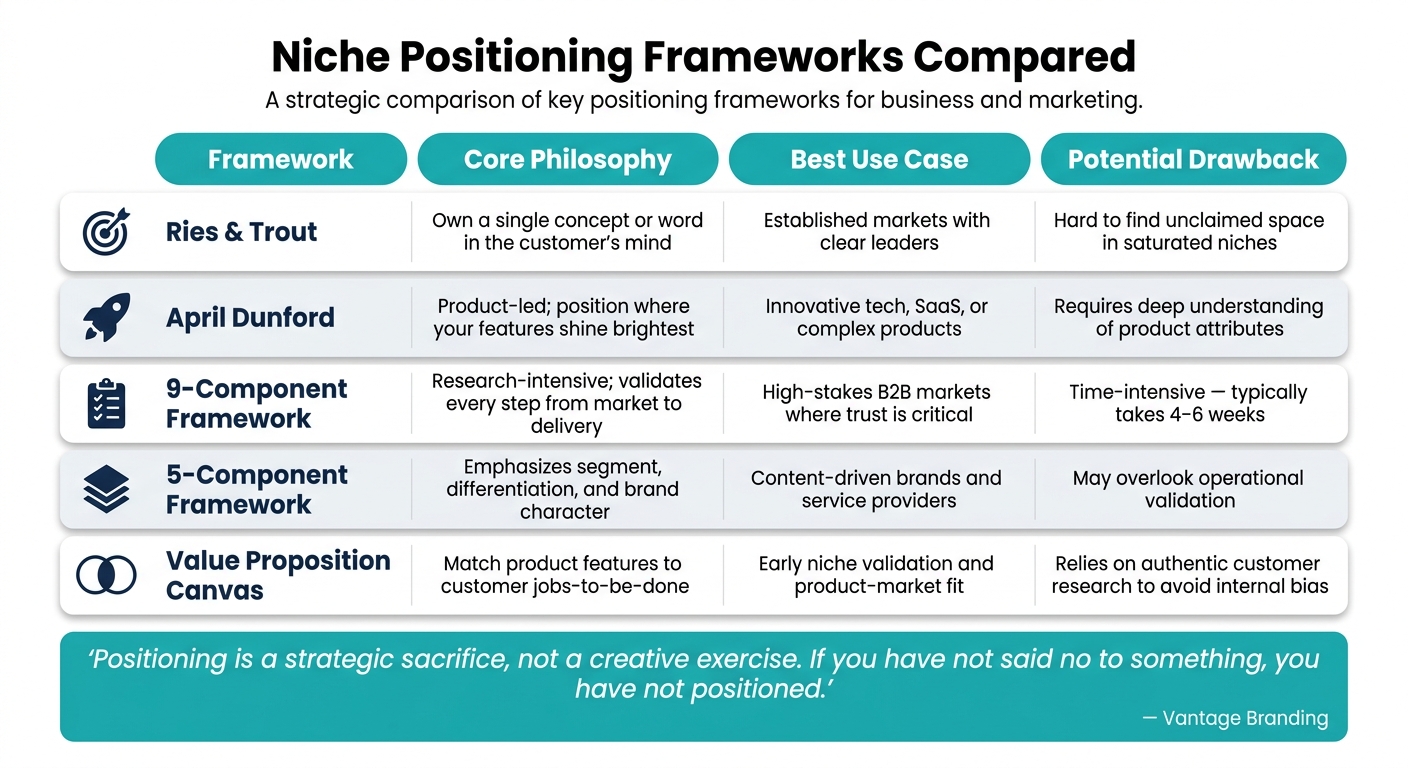
Comparing Niche Positioning Frameworks
The right framework depends on your product’s stage, market dynamics, and strategic goals. Each option builds on the principles of clarity and differentiation, offering unique strengths and challenges.
| Framework | Core Philosophy | Best Use Case | Potential Drawback |
|---|---|---|---|
| Ries & Trout | Focus on owning a single concept or word in the customer’s mind | Established markets with clear leaders | Difficult to find unclaimed space in saturated niches |
| April Dunford | Product-led approach; positions your product in a category where its features shine | Ideal for innovative tech, SaaS, or complex products | Requires deep understanding of product attributes |
| 9-Component Framework | Research-intensive; validates every step from market to delivery | High-stakes B2B markets where trust is critical | Time-intensive, often taking 4–6 weeks |
| 5-Component Framework | Emphasizes segment, differentiation, and brand character | Great for content-driven brands and service providers | May overlook operational validation |
| Value Proposition Canvas | Matches product features to customer jobs-to-be-done | Best for early niche validation and product-market fit | Relies heavily on authentic customer research to avoid internal bias |
If your product is breaking new ground, April Dunford’s framework helps you find the right context. For crowded markets, Ries & Trout can help pinpoint a specific gap. And if you’re concerned about overpromising, the 9-component framework ensures your positioning aligns with operational realities.
“Positioning is a strategic sacrifice, not a creative exercise. If you have not said no to something, you have not positioned.” – Vantage Branding




Turning Niche Positioning Into Brand Experience
Once you’ve defined your niche, the next step is to turn it into a cohesive brand experience. A strategy is just words on paper unless your audience interactions consistently reflect it. Every touchpoint matters when it comes to standing out in a crowded market.
Keeping Visual Identity and Messaging Consistent
Your niche positioning should influence everything – your logo, website, social media presence, and even customer service. Every interaction either strengthens or weakens your brand’s position.
A practical way to test your messaging is by using the “Only” test. This helps ensure your brand communicates a clear and specific value.
Strong niche brands use layered messaging to address external, internal, and philosophical concerns. For instance, a pharmaceutical logistics company that focuses on “cold-chain compliance” rather than generic terms like “reliable shipping” speaks directly to these layers. This approach reinforces the niche positioning, making the brand more memorable and differentiated.
“If you are selling to everyone, you are selling to no one.” – Stuart Crawford, Creative Director, Inkbot Design
If your homepage leans on overused terms like “innovative”, “client-focused”, or “synergy”, your messaging might be blending in rather than standing out. Precise, niche-specific messaging can significantly lower customer acquisition costs – by up to 50% – and boost marketing ROI by 30%.
Designing Customer Journeys for Your Niche
Generic customer journeys won’t cut it for niche brands. Every interaction, from the first touchpoint to post-sale follow-ups, should be tailored to your audience’s specific needs.
Take Brand3’s work with Gerety Insurance as an example. By redesigning their customer journey, they tripled leads and increased conversions by 52%. A customized journey isn’t just a nice-to-have – it delivers better results.
“True brand positioning is not about figuring out what to add to your messaging; it is about figuring out what to remove.” – Adessi
For agencies like Visual Soldiers, this principle is foundational. Their approach ensures that visual identity, website structure, and messaging all align with the needs of a clearly defined niche audience.
Once your tailored customer journey is in place, it’s important to track specific metrics to measure its success.
Measuring the Results of Niche Positioning
To know if your niche strategy is working, focus on the right metrics. A successful approach often leads to fewer leads overall but significantly improves lead quality and revenue. When done right, niche messaging not only attracts the right audience but also enhances operational efficiency.
Here are some key metrics to monitor:
| What to Measure | What It Tells You |
|---|---|
| Search visibility for long-tail keywords | Whether your niche expertise is reaching the right audience |
| Lead quality and conversion rate | Whether you're attracting serious buyers instead of casual browsers |
| Pricing power and sales cycle length | Whether your brand is perceived as a specialist (shorter cycles and less price haggling) |
| Customer retention and referral rate | Whether your niche audience feels understood and remains loyal |
Research shows that high-growth professional services firms are 75% more likely to specialize than slower-growing ones. Specialization often leads to shorter sales cycles, better retention, and the ability to price based on value rather than cost.
“Generalists compete on price. Specialists compete on value.” – Stuart Crawford, Creative Director, Inkbot Design
Find the Position Only Your Brand Can Own
Book a Discovery CallConclusion: What Niche Positioning Does for Your Brand
Niche positioning redefines how your brand is perceived by zeroing in on a specific audience and their unique needs. It allows you to compete on the value you provide, not just on price, fundamentally shifting how customers view your brand, how quickly they trust you, and how loyal they remain over time.
The numbers speak for themselves. A shift toward niche-focused messaging tailored to a target audience led to a 137% increase in active users and a 52% boost in conversions, with total leads tripling. This isn’t just a strategy – it’s a proven path to growth.
Over time, niche positioning establishes lasting brand authority. By clarifying your unique value, it simplifies operations and creates stronger customer relationships. These aren’t just transactional connections – they’re the kind that turn customers into passionate advocates. As Visual Soldiers aptly notes, “A well-crafted brand identity doesn’t just make a good first impression; it builds lasting relationships.”
To keep your niche positioning strong, make it a habit to conduct quarterly audits of your website, ads, and social content. This ensures your messaging stays aligned with your target audience and remains distinct. If your positioning statement could easily fit another brand with just a logo change, it’s time to refine it. Brands that consistently stand out are the ones that treat positioning as an ongoing commitment, not a one-time task. This consistent focus doesn’t just set you apart today – it lays the groundwork for continued growth in the future.
FAQs
Choosing a niche can speed up growth by making your brand easier to recommend and allowing for higher pricing. Think of it as a focused strategy rather than shutting out possibilities. To find the right niche, look back at your past wins – situations where you delivered measurable results and earned solid profits. Shift into your niche gradually by fine-tuning your current offerings and crafting messaging that appeals to your ideal audience, all while maintaining relationships with your existing clients.
To determine if your brand positioning stands out, ask yourself: Could your brand description work just as well for a competitor if you swapped the logo? If the answer is yes, it’s time to revisit your strategy. Focus on uncovering why your benefits are important to customers and how they set you apart – like leveraging proprietary technology or exclusive features. Back up your conclusions with real-world data. Conduct customer interviews, analyze reviews, and map out competitors to confirm your positioning is both relevant and distinctive.
To see if your niche positioning is hitting the mark, keep an eye on key metrics like website traffic, social media engagement, sales figures, Net Promoter Scores, repeat purchase rates, and average order values. But numbers aren’t the only indicators. Pay attention to qualitative signs too – like having more meaningful conversations with prospects or receiving referrals that align closely with your ideal client profile.
Other positive signals? Shorter sales cycles, the ability to maintain stronger pricing, and improved customer retention. These all point to a brand that’s connecting with your audience and addressing their specific needs effectively.

Visual Soldiers
Visual Soldiers is an Atlanta-based creative studio specializing in branding, design & digital experiences.