How to Leverage Brand Equity
Quick Summary
Brand equity is a crucial factor in the success of companies like Apple and Nike, as it influences why customers prefer certain brands over others, often leading them to pay a premium for similar products. When effectively developed, brand equity can significantly enhance customer loyalty, reduce marketing expenses, and potentially increase revenue by up to 30%. This article explains that brand equity is essentially the value added to a brand based on consumer perceptions, trust, and experiences. Understanding and leveraging brand equity is important because it plays a key role in driving customer loyalty and justifying premium pricing.
Brand equity is the secret weapon behind the success of companies like Apple and Nike. It’s why customers trust, remember, and choose certain brands over others – often paying more for the same product. Done right, it can boost loyalty, cut marketing costs, and increase revenue by up to 30%.
Here’s what you’ll learn:
- What brand equity is: It’s the value your brand adds based on consumer perception, trust, and experiences.
- Why it matters: Strong brand equity drives customer loyalty, premium pricing, and long-term growth.
- How to measure it: Track awareness, perception, behavior, and financial metrics to evaluate your brand’s health.
- How to use it: Build trust, differentiate your brand, and expand into new markets with less risk.
This guide will show you how to measure, manage, and grow your brand equity for lasting business success.
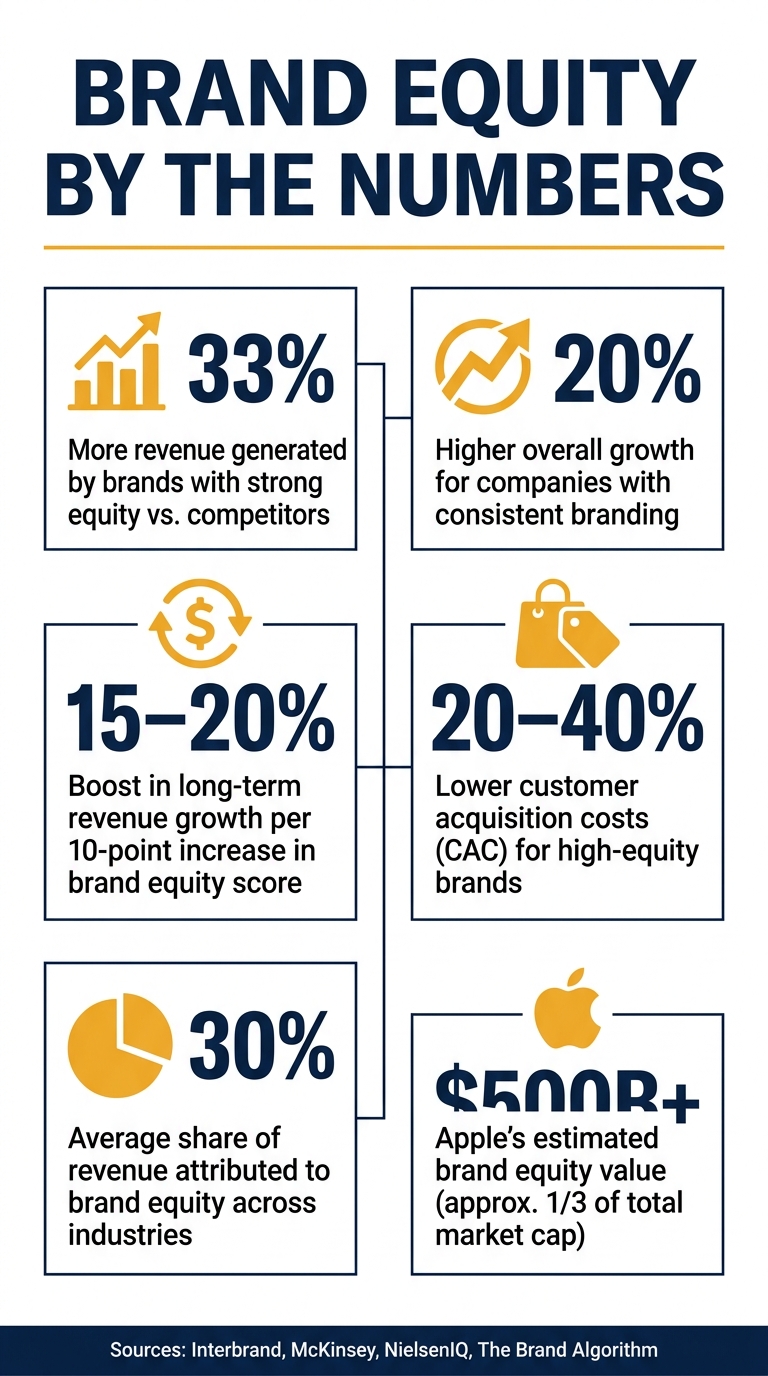
Brand Equity by the Numbers: Key Stats That Prove Its Business Impact
Understanding Brand Equity
What Is Brand Equity?
Brand equity refers to the added value a well-known brand brings to a product when compared to a generic alternative. This value is shaped by consumers’ awareness, emotions, and personal experiences with the brand. It’s the reason someone might choose your product over a less expensive, lesser-known competitor.
Two widely recognized approaches explain how brand equity is built. David Aaker’s model breaks it down into five key elements: brand loyalty, brand awareness, perceived quality, brand associations, and proprietary assets like trademarks and patents. On the other hand, Kevin Keller’s Customer-Based Brand Equity (CBBE) Pyramid takes a psychological route. It outlines four stages for brands to progress through: establishing identity (“Who are you?”), defining meaning (“What are you?”), shaping judgments and feelings (“What do I think of you?”), and building a meaningful relationship (“What about our relationship?”).
“A brand is a set of mental associations, held by the consumer, which add to the perceived value of a product or service.” – Kevin Lane Keller, Author of Strategic Brand Management
In simple terms, building equity starts with creating strong brand identity and associations. From there, it evolves into deeper consumer connections.
Brand Equity vs. Brand Value
While the terms “brand equity” and “brand value” are sometimes used interchangeably, they’re not the same. Understanding the distinction is crucial for using brand equity as a strategic advantage.
- Brand equity is about perception – how customers feel and think about your brand.
- Brand value is the financial outcome of that perception, representing the brand’s worth as an asset.
Here’s how they differ:
| Feature | Brand Equity | Brand Value |
|---|---|---|
| Location | Resides in the consumer's mind | Appears on the company's balance sheet |
| Focus | Built on trust, loyalty, and associations | Reflected in revenue, profit margins, and asset worth |
| Measurement | Evaluated through surveys, sentiment, and recall | Measured via market share, price premiums, and financial valuation |
| Function | Encourages consumer preference | Translates preference into financial results |
A prime example of this connection is Apple. Interbrand estimated that Apple’s brand equity alone was worth over $500 billion – about one-third of the company’s total market capitalization at the time. This massive figure wasn’t tied to any specific product but to decades of cultivating trust and positive associations.
The Impact of Strong Brand Equity
Strong brand equity does more than make your brand recognizable – it actively shapes customer behavior. It allows businesses to charge higher prices, maintain customer loyalty, and expand into new markets with less risk because consumers already trust the brand.
Here are some numbers that highlight its importance:
- Brands with strong equity generate 33% more revenue than competitors.
- Companies with consistent branding often see 20% higher overall growth.
- A 10-point increase in brand equity scores typically leads to a 15–20% boost in long-term revenue growth.
“An effective brand resonates with consumers. It powers their purchasing decisions and reflects who they are and what they stand for.” – Jill Avery, Professor, Harvard Business School
Moreover, strong equity acts as a shield during tough times. For instance, after Facebook rebranded to Meta, its trust score plummeted from 16% to 5.6% in just a year, showing how fragile brand equity can be and how it directly affects financial performance.
In short, brand equity isn’t just a marketing buzzword – it’s a core asset that requires careful management. These insights set the stage for evaluating and improving your brand’s current equity.

How to Assess Your Current Brand Equity
Key Metrics for Measuring Brand Equity
To improve your brand equity, you first need to understand your current standing. This involves evaluating four key areas: awareness, perception, behavior, and financials. Together, these metrics create a comprehensive picture of your brand’s health.
Awareness reflects how easily customers recall your brand without assistance. For example, unaided recall – when customers can name your brand spontaneously within a product category – is a stronger indicator than aided recognition, where they select your name from a list. Tools like Google Trends can help you track branded search volume to supplement recall data.
Perception delves into what your brand means to customers. This includes how they perceive its quality, trustworthiness, and the attributes they associate with it. Moving to behavioral metrics, these reveal whether those perceptions lead to action. Key indicators include repeat purchase rates, Net Promoter Score (NPS), customer lifetime value (LTV), and churn rates. Lastly, financial metrics quantify the economic impact of your brand. They measure factors like the price premium customers are willing to pay for your brand over generic options and the proportion of revenue generated from brand-driven channels like direct traffic and branded search. For context, strong brands often derive 30–50% of their revenue from these channels.
| Metric Category | What to Measure | What It Reveals |
|---|---|---|
| Awareness | Unaided recall, branded search volume | Whether your brand is part of the customer's mindset |
| Perception | Perceived quality, attribute associations | How customers define and differentiate your brand |
| Behavioral | NPS, repeat purchase rate, churn | Whether customers choose and remain loyal to you |
| Financial | Price premium %, brand-driven revenue % | The tangible economic value your brand creates |
Interestingly, customers familiar with your brand often have a 2–3x higher lifetime value compared to those who aren’t aware of it. This makes tracking awareness a critical aspect of assessing your brand equity.
How to Build a Brand Equity Scorecard
Once you’ve gathered your data, organize it into a Brand Equity Scorecard – a tool that provides a clear and concise view of your brand’s health for leadership teams.
Start by selecting 8–12 key metrics that span awareness, perception, preference, and financial performance. To make the data easier to interpret, normalize all metrics to a 0–100 scale. This allows you to combine different types of data, like survey results, NPS scores, and financial ratios, into a unified framework. You can then create a weighted Brand Equity Index (BEI) based on your business priorities. For instance, you might allocate 25% to awareness, 30% to meaning, 25% to differentiation, and 20% to commitment.
To make the scorecard actionable, use color-coded thresholds – green for strong performance, yellow for areas needing attention, and red for critical issues. Add a competitive dimension by benchmarking your data against the top 3–5 competitors, normalizing their scores to the same scale (e.g., setting the category leader at 100). This helps you pinpoint gaps and opportunities. Research indicates that a 10-point increase in composite equity scores can lead to a 15–20% boost in long-term revenue growth.
“Brand equity is only useful as a measurement system when it can survive a hostile meeting. It has to stand up to finance, to sales, to the board.” – The Brand Algorithm
Review your scorecard quarterly to stay on top of market changes. If critical metrics like trust or relevance drop unexpectedly, treat it as a signal to conduct qualitative interviews. This can help you identify and address underlying issues before they escalate.

The Power of Brand Equity
Using Brand Equity to Differentiate Your Business
Once you’ve completed your scorecard analysis, the next step is to turn those numbers into a meaningful market stance. Your Brand Equity Scorecard isn’t just a tool for measurement – it’s a way to carve out a distinct identity in a crowded marketplace. Strong brand equity becomes your competitive edge, helping you stand out and stay top of mind.
Aligning Equity Insights with Brand Positioning
The data from your Brand Equity Scorecard can guide you in refining your positioning. Focus on amplifying your strengths rather than overhauling your image. By doubling down on what you already do well, your differentiation feels authentic and effortless.
A helpful approach is to center your strategy around three key areas:
- Mental availability: Are you the go-to brand customers think of first?
- Brand image: What associations and meanings do people link to your brand?
- Brand attachment: How emotionally connected are customers to your brand?
Align your positioning with the pillar where you already excel. This ensures your differentiation feels organic and resonates with your audience.
To keep your messaging clear and consistent, try the XYZ formula: “We help [X] do [Y] by [Z].” This formula can guide everything from product decisions to marketing campaigns and partnerships.
“Brand building is about building potential in people’s minds today, which will influence their future purchases. The best way to truly capture brand performance is to simulate these future decisions, today.” – Trevor Godman, Global Practice Lead, Brand, NIQ
A standout example of this strategy is Nespresso. Instead of competing on price with regular coffee brands, Nespresso leaned into its premium positioning. Through curated boutiques, elegant packaging, and a controlled customer experience, they established a unique place in consumers’ minds.
Consistency is key – make sure this refined positioning is reflected across every interaction your brand has with customers.
Keeping Your Brand Consistent Across Touchpoints
Once your positioning is set, consistency across all channels is vital. Mixed messages and inconsistent branding can erode trust and confuse your audience.
To ensure uniformity, develop a tone matrix to standardize your brand voice for various contexts. Combine this with a Digital Asset Management (DAM) system to provide teams with approved logos, templates, and messaging guidelines. This approach helps prevent brand dilution and keeps communication sharp and cohesive.
Comparing Differentiation Approaches
Not all strategies for standing out influence brand equity in the same way. Below is a comparison of three common approaches, highlighting their pros, cons, and impact on brand equity:
| Strategy | Pros | Cons | Effect on Brand Equity |
|---|---|---|---|
| Price-led | Boosts short-term sales; appeals to budget-conscious buyers | Reduces pricing power; easy for competitors to replicate; often unsustainable | Negative: Can lead to over-reliance on discounts, weakening long-term brand appeal |
| Experience-led | Builds loyalty and advocacy; fosters a deeper emotional connection | Requires significant investment in improving customer experience | Positive: Creates strong emotional bonds and elevates brand perception |
| Purpose-led | Aligns with values like sustainability and ethics | Risks backlash if the message feels insincere | Positive: Enhances trust and strengthens brand image when done authentically |
While experience-led and purpose-led strategies may take longer to show results, they offer lasting benefits to your brand equity, making them worthwhile in a competitive landscape.
Using Brand Equity to Drive Business Growth
Strong brand equity acts as a powerful driver for business growth, building on differentiation strategies. Once established, it can help you break into new markets, reduce customer acquisition costs, and attract partnerships with those who see real value in your brand.
Expanding Markets and Product Offerings
When your brand is already trusted, stepping into a new market or introducing a new product becomes far less daunting. This concept, often called “brand stretch”, leverages existing consumer trust to explore related categories. However, it’s crucial to expand thoughtfully – sticking to areas that align with your brand’s identity. Straying too far from your core can confuse customers and weaken the very qualities that set your brand apart.
Lowering Marketing and Sales Costs
High brand equity doesn’t just boost trust – it also cuts costs. Brands with top-tier equity enjoy 20% to 40% lower customer acquisition costs (CAC) compared to those with weaker equity. Why? Because consumers who trust your brand are more likely to seek you out and convert faster. This reduces the need for heavy marketing and sales efforts, while also strengthening revenue streams and increasing your market reach.
“Short-term marketing can win the moment; brand equity wins the future. When you build memory, meaning, and desire, you earn consumers’ ‘automatic yes’ – the instinctive choice that reduces friction at the shelf and in search.” – Stacy Bereck, Global Practice Leader, Consumer Insights and Brand, NIQ
Building Partnerships and Licensing Deals
Strong brand equity reshapes how potential partners view your business. When consumers actively seek out your brand, opportunities often come to you instead of the other way around. Partners are drawn to the audience and trust you’ve cultivated.
“If consumers are actively seeking your brand, you stop ‘asking for space’ and start earning it. That changes everything – from shelf position to media opportunities to category leadership.” – NielsenIQ
This influence extends to licensing deals and even mergers or acquisitions. A brand with strong consumer loyalty represents lasting value that’s difficult for competitors to replicate. In fact, brand equity contributes to an average of 30% of revenue across various industries. However, before entering partnerships, it’s essential to assess value alignment to prevent weakening your brand. Next, explore how to weave brand equity into your business operations for long-term success.



Making Brand Equity Part of Your Business Operations
Brand equity delivers lasting value when it becomes part of daily business operations – not just a marketing initiative. This means incorporating brand health into everything from pricing strategies and product planning to hiring decisions and quarterly reviews.
Using Brand Metrics to Guide Business Decisions
Develop a Brand Equity Index (BEI) to consolidate key metrics into a single, actionable score ranging from 0 to 100. This score combines indicators like unaided recall, perceived quality, NPS, and price premium. A drop in the score sparks immediate discussions, while an increase highlights what’s working.
Focus on tracking four key metric categories:
- Awareness: Metrics like unaided recall and branded search volume.
- Perception: Includes quality ratings and net sentiment.
- Preference: Covers consideration rates and win rates.
- Financial: Factors like price premium and branded vs. non-branded CAC.
This balanced approach avoids relying on vanity metrics that don’t connect to revenue. Research indicates that improving composite brand equity scores by 10 points can lead to a 15–20% increase in long-term revenue growth. Numbers like these make brand equity a critical conversation at the executive level.
The BEI framework also helps align teams across the organization, ensuring consistent brand delivery.
Getting Your Teams Aligned on Brand Values
Brand consistency doesn’t happen by chance. Clear, role-specific guidance ensures employees outside of marketing understand how their decisions impact the brand experience. For instance, empathetic customer support can reinforce brand values just as effectively as a well-planned ad campaign.
Dynamic brand guidelines, hosted online instead of buried in static PDFs, make this alignment easier. Real-time updates ensure all teams are working with the latest information, reducing the risk of outdated materials sneaking through. Pair these guidelines with practical training that translates brand values into tangible actions for each department. For example:
- For the product team, define what “quality” looks like.
- For sales, explain how to embody “trust.”
- For customer experience, clarify what “consistency” entails.
Measuring and Refining Brand Equity Over Time
Once teams are aligned, continuous monitoring is key to keeping your brand a strategic asset. Annual audits are too infrequent. Instead, adopt quarterly reviews to keep brand equity dynamic and actionable. These reviews should address three critical questions:
- What changed?
- Why did it change?
- What actions – whether creative, pricing, or positioning – should follow?
Assign ownership of specific metrics and establish thresholds for score changes that trigger immediate strategy reviews. Static annual tracking misses real-time market shifts, which account for 40% of brand mismeasurements. A quarterly rhythm ensures your brand adapts to changing conditions.
“Brand building is about building potential in people’s minds today, which will influence their future purchases. The best way to truly capture brand performance is to simulate these future decisions, today.” – Trevor Godman, Global Practice Lead, Brand, NIQ
Set aside 0.5%–2% of your total marketing budget for brand tracking. This small investment protects your revenue and ensures your brand remains a competitive advantage.
Conclusion: Putting Brand Equity to Work for Long-Term Success
Brand equity isn’t something you build once and forget – it’s a dynamic asset that thrives when nurtured through consistent measurement, actionable insights, and alignment across every customer interaction. The most successful companies treat brand health as seriously as they do revenue, with clear ownership, regular evaluations, and accountability baked into their processes.
Now’s the time to take action based on your brand assessment. Focus on what sets your brand apart. Make those differentiators a core part of your messaging, design, and customer experience. Leverage your equity to guide critical growth decisions – whether it’s adjusting pricing, launching new products, or forming strategic partnerships. Research highlights the advantage: brands with strong equity can sustain price premiums of 20–40% over their competitors, while McKinsey data reveals that design-focused companies can outperform industry revenue benchmarks by up to two-to-one over a five-year span.
Consistency is key, and inconsistent visuals can weaken your brand equity. This is where working with a specialized creative partner can make a difference. An agency like Visual Soldiers, based in Atlanta, excels in translating brand strategy into a unified system. From logos and typography to UX design and ad creative, they ensure all touchpoints tell a cohesive story. Their process starts with a strategic discovery phase to align with your business objectives and understand your competitive landscape.
“Choosing a creative partner is daunting. Our experience with Visual Soldiers confirmed that strategic discovery and precise delivery make all the difference.” – Tim Muenchen, VP of Sales & Marketing, FLS Transport
Stop Leaving Brand Growth to Chance
Strong brands aren't built by accident. They're built through strategy, consistency, and experiences that customers remember. At Visual Soldiers, we help ambitious companies transform their brands into measurable business assets through strategic branding, digital experiences, and marketing that drive long-term growth. Ready to build a brand people choose, trust, and remember?
Let's TalkFAQs
Building strong brand equity isn’t something that happens overnight. It’s a gradual process that thrives on consistent effort, clear communication, and dependable customer experiences. Instead of relying solely on quick, flashy campaigns, it’s the accumulation of many small, positive interactions that truly makes a difference. While initiatives like rebranding might take a few months to execute, earning long-term consumer trust and building a solid reputation requires ongoing commitment and continuous investment in both your brand and the relationships you nurture.
To calculate a Brand Equity Index (BEI) in the simplest way, start by standardizing key metrics on a consistent scale, such as 0 to 100. Higher values on this scale indicate stronger performance. The BEI revolves around four main pillars:
- Salience: Measures how easily your brand comes to mind (e.g., unaided awareness).
- Meaning: Reflects how well your brand resonates with its target audience.
- Difference: Captures what sets your brand apart from competitors.
- Commitment: Indicates the level of loyalty and dedication customers have toward your brand.
Each pillar is evaluated using weighted averages of relevant metrics. Once you have these scores, combine them to create the final index. Regularly monitoring your BEI offers valuable insights into your brand’s performance, including its influence on pricing strategies and market share.
To grow your brand without losing its essence, begin by conducting a detailed brand equity analysis. This helps you gauge how far your brand can stretch while staying true to its roots. Any new product or service should align closely with your brand’s core identity, making it feel like a natural extension rather than a departure.
Before introducing anything new, ensure your team and resources are fully equipped to deliver top-tier quality in the new category. A solid positioning strategy is essential – this keeps your messaging clear and ensures the new offering complements your existing brand. Above all, maintain a consistent customer experience that reflects your original brand promise. Consistency builds trust and keeps your brand recognizable, even as it evolves.

Visual Soldiers
Visual Soldiers is an Atlanta-based creative studio specializing in branding, design & digital experiences.